
World Mental Health Day seems a good time to take another look at Netflix’s Breaking Point documentary on Marty Fish.
As part of Netflix’s Untold sports series, the documentary traces in 80 minutes, the story of the former US No. 1 from his days as a USTA Development player through to his ascendency to World No. 7. Featured is footage from some of the great matches he played, as well as some wonderful vision of Jimmy Connors and Roger Federer at their best.
But this history is the context for the documentary’s primary focus on the effects of Fish’s professional tennis career on his mental health.

Breaking Point details how, in 1988, the USTA began planning a nationwide program to develop and support talented players on scholarships at training centres around the US. There were concerns that US champions were getting older.
US Professional Tennis Registry President Dennis Van der Meer explained at the time, “We are going to take the best 1000 kids, and [of those, tell] 500 ‘you are out’. Now we are going to leave 200, ‘the rest of you are out’. Now we have 10 and out of these 10 we must develop a champion.”
The assessment of which players made it through was based on physical, emotional and mental skills, and the potential to do well in Grand Slams and the Davis Cup.

Fish left his parents in 1994, at the age of 15, to train at the Saddlebrook Tennis Academy in Florida. The Academy offered a structured routine of tennis before school, then a few hours at school, and back on court by 1pm.
American multi-grand slam winners Pete Sampras, Jim Courier and Jennifer Capriati trained there, along with Swiss 25-time slam winner in singles, doubles and mixed, Martina Hingis.
Kevin O’Connor, the director of Saddlebrook says, “When I first watched Marty, there was nothing you would say, ‘this guy’s a prodigy; this guy’s going to be world class’.
“There was the part that was flat-footed, there was the part that you’d go that forehand is pretty terrible. But, man, his mind intrigued me. Marty would pull you wide and the short ball would come and he’d snap this cross-court angle and you’d go ‘wow, shit, that’s a big shot’. So I went to the USTA and said, I want Marty at Saddlebrook.”
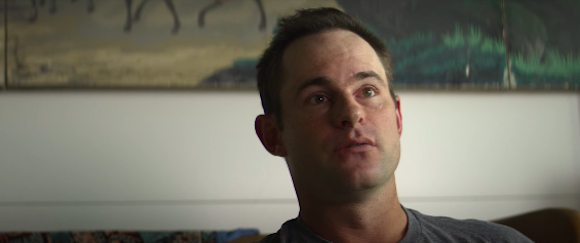
After arriving at Saddlebrook, Fish was struck by fellow attendee Andy Roddick. “This kid was different. His competitiveness was different to any of the other kids that you played. Andy had this fire to him; very intense – ruthless on the court to the point where I would give in a little bit. He wanted to win almost too bad. That’s one of the reasons, if not the main reason, he had his Hall of Fame career.”
Fish lived with the Roddick family, which had a different attitude to tennis training to his own family. Roddick’s father would get Fish up at 5am to do stretching exercises. “The Roddicks took me from a top player in the country to a top player in the world.”
Throughout the documentary, 2003 US Open winner Roddick is a continual presence and insightful commentator – Breaking Point is in many ways a documentary about him also.
Fish describes his 2003 match against Roddick in Cincinnati as “my first massive heartbreak kind of loss. And it still hurts.”

The inability to let go of “uncomfortable thoughts” and the pressure to live up to the fans’, the media’s and his own expectations led to severe anxiety.
He goes on to describe having to play Federer, “you could just never breathe”. Then in 2005, “a guy like Nadal came along.” And then in 2007 “a guy named Novak Djokovic…The three top rated guys of all time in the exact same generation.”
At the age of 28, he made changes in his diet and training in attempt to become more competitive. The following year, he played his friend Frank Dancevic in a quarter final at Newport, and after falling behind in the match, he had a meltdown directed at Dancevic.
“I did whatever it took to win. I lost a friendship but had to do it. Like, this match was the turning point that changed my life. It really did, it changed my life.”

Fish explains how some players feel the need to show a tough front to opponents and the whole tennis world. “I’d never been around anyone with mental health issues, I just didn’t know where to go with it and no one knew what I was going through. I had trained myself to show no weakness and that was something that I was proud of… but telling other people about it was showing weakness… so I just always kept it inside.”
Despite the similarities in their stories, each player who speaks about tennis and mental health, including Naomi Osaka and most recently, Caroline Garcia, has their own version to tell.
The documentary was directed by Chapman Way and Maclain Way, who developed the series for Netflix, and first streamed in 2021.