
Historically August 9th is a significant date because… in 1173, the foundations of the Tower of Pisa were laid… in 1815, Napoleon Bonaparte was exiled to the island of Saint Helena. Not to be overlooked, in 1900, the inaugural International Lawn Tennis Challenge between the US and the British Isles – which would become the Davis Cup – concluded when Dwight Davis and Holcombe Ward defeated Ernest Black and Herbert Roper Barrett, 6-4, 6-4, 6-4 to make the score 3-0 in the tie played at Longwood Cricket Club in Boston.
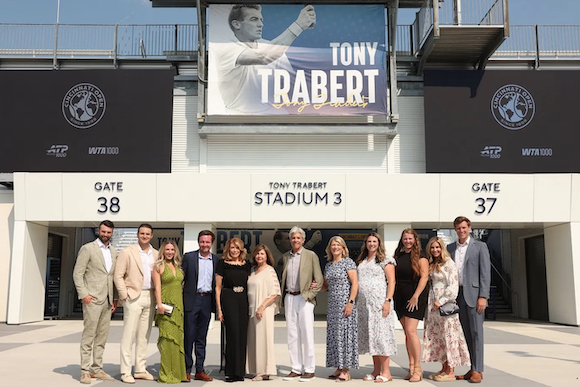
Eight hundred and fifty-three years… 311,570 days to be exact from the Tower of Pisa’s beginning, the Cincinnati Open saluted Tony Trabert… and for those who received invitations to attend the August 9th exclusive affair, it was monumental.
The “Join with the Stars” activity honored Trabert on the Sunday of Community Weekend, a family-friendly event featuring a 5 km run, children’s activities and tennis watching opportunities.
Previously, the tournament website had noted, “The Western & Southern Open (now the Cincinnati Open) honored Cincinnati tennis legend Tony Trabert in 2021 to celebrate his life and legacy…. “The city of Cincinnati and the suburb of Mason held Tony Trabert Day on August 16th which would have been his birthday after his passing February 3, 2021 at the age of 90.”
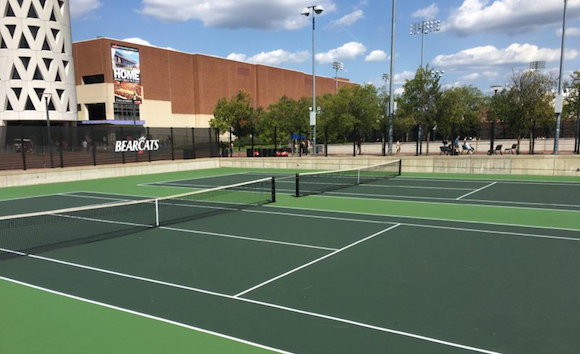
The Lindner Family Tennis Center, where the Cincinnati Open is played, has 31 outdoor and six indoor courts… During the tournament nine of the courts are used, including the Center, Grandstand and Champions Courts along with Stadium 3 and Court 10.
Prior to August 9th, the facility hadn’t dedicated any of its tennis courts, which is the reason the “Tony Trabert Stadium 3” naming was “Cincinnati Consequential…”
Six-year-old Tony Trabert, the youngest of Archie and Bea Trabert’s three boys, followed his brothers Marc and Douglas to the park, a short walk from their home. There they played tennis on the clay courts.
Growing up he starred as a catcher on the Little League team and was a Cincinnati Reds fan. Baseball was appealing but a discussion with his father convinced him it would be in his best interest to concentrate on one sport… and the chess-like aspect of tennis carried the day. Earl Bossang and Howard Zaeh, local teaching professionals, lay the foundation for Trabert’s unfaltering groundstrokes.
More important… at the 1942 Tri-State Tennis Championships (as the Cincinnati Open was known), he began what would become a life-long friendship with Bill Talbert, who was also from Cincinnati.
In “Tony Trabert – 70 Years Later”, a story that appeared in Sam Kouvaris’ Samsportsline, October 2020 publication, Trabert remembered, “He had taken me under his wing when I was 12. He saw me swinging at volleys and came on the court to help.”
At the time, Talbert was ranked in the US Top 10, a position he retained for 13 years. Later in 1942 at the US National Championships, he teamed with Gardnar Mulloy to win the first of his four doubles titles at Forest Hills, New York.
As a student at Walnut Hills High School, Trabert became the first player to win the Ohio High School Tennis Championship three consecutive years from 1946 -’48. In the fall of ’48, he enrolled at the University of Cincinnati and played basketball and tennis.
In 1950, his tennis world changed dramatically when Talbert, one the game’s elite competitors who had never played in Europe, and was also coached by Zaeh, asked the 19-year-old Trabert if would be interested in playing doubles with him that spring and summer. Talbert’s wife Nancy would accompany them.
Before agreeing Trabert told Kouvaris he spoke with his parents along with the President of the University of Cincinnati, who pointed out, “You’ll learn more in three months there than you would in three months going over books at school.”
Prior to trip, Talbert asked the United State Lawn Tennis Association (USLTA) for “travel expenses”, but the request was denied because the organization didn’t believe Trabert was “…going to be any good”.
From early April through early July, Talbert and Trabert played Monte Carlo, the Nice Tennis Championships, and the Internazionali d’Italia in Rome before going to Paris for the Paris City Championships and Roland Garros. They then crossed the Channel for Queen’s and The Championships.
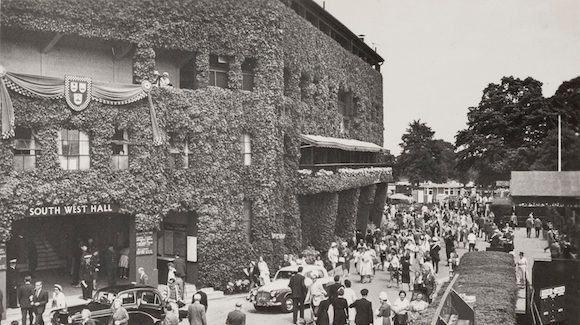
Fortunately, the circuit was different in those days. Tournaments and the host clubs provided accommodation and offered travel expenses. Given Talbert’s reputation as a US player, he and Nancy found ways to optimize the groups’ financial survival, aided by the fact that the more Talbert and Trabert won, the more substantial their funding became…
And win they did… In Monte Carlo, they defeated Vladimír Černík and Jaroslav Drobný 3-6, 6-4, 4-6, 6-1, 7-5 in the Men’s Doubles final. As Trabert told Kouvaris, “We played Jaroslav Drobny, a lefthander from Czechoslovakia, and his partner. He’d kick his serve to my forehand, and I’d never seen that before. I finally figured it out and we won in the fifth set.”
At the Internazionali d’Italia, the duo defeated Budge Patty and Bill Sidwell 6-3, 6-1, 4-6, (retired). At Roland Garros, they teamed for their first Grand Slam title downing Drobný and Eric Sturgess, 6-2, 1-6, 10-8, 6-2.
At The Championships, Talbert teamed with his regular partner, Gardnar Mulloy. Though seeded No. 1, they lost in the third round. Trabert and Patty, who were unseeded, reached the semifinals.
Their singles success was similarly impressive… Talbert was a finalist to Drobný at Monte Carlo and the Internazionali d’Italia. Patty defeated Trabert for the men’s honors at Nice. Talbert defeated Herb Flam in the Paris City Championships final. At Roland Garros, John Bromwich downed Talbert in the quarterfinals and Drobný defeated Trabert in the fourth round. At The Championships, Talbert was a quarterfinalist to Patty, the tournament winner, and Trabert was defeated by Tony Mottram in the second round.
(Complete Nice Tennis Championships, Paris City Championships and Queen’s men’s draws are not available.)
After The Championships, they returned home and Trabert again became a University of Cincinnati student and majored in political science. He explained the impact of his first visit to Europe to Kouvaris, “That was a big jump start. By far the most important thing, tennis wise, to happen to me. I saw more silverware in front of me at dinner one night in Europe than we had in our whole house. I learned so much, and not just about tennis. Writing thank you notes, how to dress, all of that.”
He continued, “Each tournament gave you something for your travel and per diem. When I finally made a little money, I told Bill I wanted to repay him. He said just do something nice for another tennis player. Which was typical of Talbert.”
Being a member of the University of Cincinnati basketball team was a 1950 fall highlight for Trabert. The next season, he was a starting guard, “… a playmaker” whose tenacious defense earned praise… The team finished with a 18-4 record and qualified for the prestigious National Invitation Tournament (NIT) played at Madison Square Garden… but lost 70-67 to St. Bonaventure in the first round on March 10th .
One hundred and five days later at the Northwestern University tennis courts, Trabert defeated Hugh Stewart of USC on June 23rd to win the 1951 NCAA Men’s Singles. Stewart earned redemption teaming with Earl Cochell to down Trabert and Bob Mault for doubles honors.
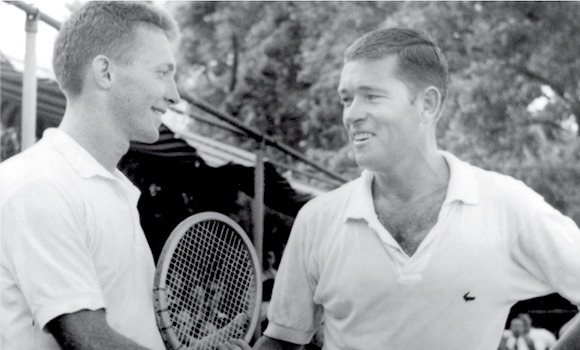
But the best was yet to come…on July 23rd after losing the first two sets 7-5, 6-4 he rallied to take the next three 6-4, 6-3, 6-4 and win his first Tri-State Men’s Singles defeating Talbert for the first time…
Trabert thoughtfully remembered, “I had played him four or five times before that. He was better than I was, he was ten years older. But he was my idol and it was hard for me to want to beat him. I have a picture of us shaking hands after the first time I beat him, and he has the most beautiful smile on his face.”
The Cincinnatians won the doubles, a second for Trabert since his inaugural Tri-State title came teaming with Andy Paton in 1949. For Talbert it was his fourth, but the victory was made even more noteworthy because it was their first trophy triumph since 1950 Roland Garros.
(Talbert, whose Tri-State Tennis Championships statistics, are unrivaled, realized a tournament double in 1943 defeating Seymour Greenberg in the singles final and earning the doubles with Alvin Bunis, who would create the Tennis Grand Masters circuit in 1973.)
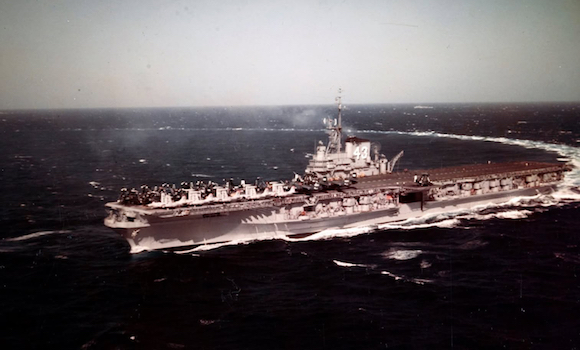
With the Korean War occupying public conscience, the local draft board felt compelled to draft Trabert because of complaints that he actually wasn’t a University of Cincinnati student, but merely a tennis player in residence. As a result, in September 1951, following a quarterfinal loss to Frank Sedgman at the US National Championships, he reported to the Naval Training Center in Norfolk, Virginia. Once training concluded, he served on the USS Coral Sea aircraft carrier that patrolled the Mediterranean from 1951 to ’53. During that time he missed nine of the 12 Grand Slam tournaments that were played.
At home firsts flourished in 1951, when the Cincinnati Tennis Club installed temporary grass tennis courts over several of the facility’s existing terra battue to host the US-Japan America Zone Davis Cup Quarterfinal, from July 25 to 27.
For Talbert, who grew up within walking distance of the club, it was the first time he served as Davis Cup captain… and it was made more memorable by winning the doubles contest with Mulloy. Dick Savitt, the 1951 Gentlemen’s winner at The Championships secured two victories. Herb Flam, who graduated from UCLA after becoming the first player from the school to win both the NCAA singles and doubles in 1950, and had been a semifinalist earlier in the month, also triumphed.
In December 1952, Trabert received a 30-day furlough enabling him to play the Davis Cup – the Inter-Zonal final against Italy, December 18-20, in Sydney, Australia and the Challenge Round against Australia in Adelaide, December 29-31.
In the 5-0 victory over Italy, he won three matches, two singles and the doubles with Vic Sexias, who was a singles winner as was Ham Richardson. Against Australia he went 0-3, losing singles encounters with Ken McGregor and Frank Sedgman and with Sexias, the doubles to McGregor and Sedgman. Sexias scored the lone US point downing McGregor to closeout a 4-1 loss.
Based in San Diego during the spring of 1953 and “Counting the days…” until his June discharge, he garnered an April leave and played “The Ojai”, a tournament that began in 1896 and was the oldest tennis championship played in one location in the country…
Trabert added his name to the storied Men’s Open Invitational Singles winners list that included Bill Tilden, Ellsworth Vines, Jack Kramer and Richard “Pancho” Gonzalez. He defeated Flam then teamed with Bill Crosby to down the Hippenstiel brothers, Glenn and Clyde, in the Men’s Open Invitational Doubles final.
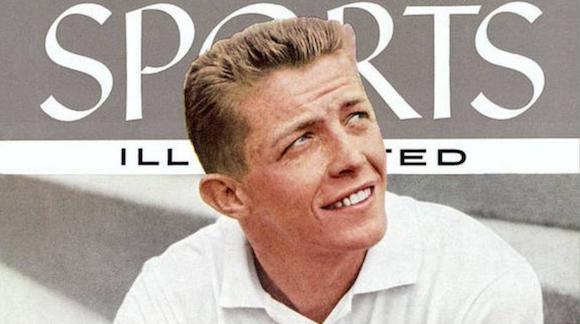
Two months later, he was again granted leave and participated in the 1953 USLTA National Men’s Hard Court Championships, June 7-13, at the Salt Lake Tennis Club. Unranked in 1952 because his military obligation didn’t allow him to play the required number of tournaments, Trabert defeated Tom Brown, who was No. 8 in the US, in the singles final, 6-4, 11-9, 6-4. The two then teamed up to win the doubles.
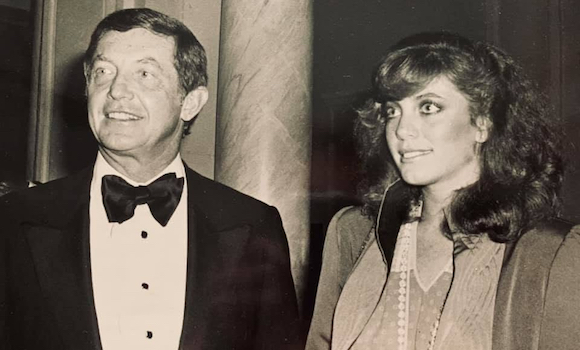
Martha Katsufrakis (née Castles), a long-time friend who grew in Salt Lake City, and became a distinguished tennis player at Forest Dale Park – where Harry James would become a legendary teaching professional – revealed, “I was running the tournament for David Freed (who would serve as US Davis Cup captain in 1960-’61). We had asked girls from the University of Utah, such as Sweethearts of Sigma Chi, etc. to be hostesses and ushers. Shauna Wood, whom I only knew to say ‘Hi’ at the university, had just become Miss Utah. (She would go on to represent the state in the Miss Universe Contest.)
“I seized the opportunity to get a publicity picture and arranged for a photo of Tony and Shauna, which I still have, and is captioned, ‘Mr. International Tennis player meets Miss Utah’. It was love at first sight.”
Katsufrakis continued, “There were rain delays during play, so they had time to visit and talk. After the tournament (and dates with Tony over that weekend), she began calling me asking what I knew about Tony and about tennis.
“They saw each other again in Long Beach (California) where the Miss Universe Contest was held because he was still stationed in San Diego. Shauna talked her chaperon into letting her eat alone with Tony, and their telephone calls started.”
Trabert played the 1953 Tri-State Championships, June 29-July 5, defeating Richardson for singles honors and teamed with him to win the doubles over Lew Hoad and Ken Rosewall.
Katsufrakis added, “The next time I saw Tony, after he had been discharged, was in Chicago at the 1953 USLTA National Clay Courts Championships in August. That was when I learned he had invited Shauna to come to the tournament in New York. Her father said she could go, but only if I went with her. I did not know Shauna that well until that time.”
At the National Championships played at the West Side Tennis Club in Forest Hills, New York, August 29th – September 7th, Trabert realized his “Released from the Navy” goal by winning the Men’s title downing Sexias, 6-3, 6-2, 6-3 and claiming his first Grand Slam singles trophy.
“Their telephone courtship started at the end of July,” Katsufrakis remembered. “They got engaged at the Nationals in New York and were married October 26th at the Salt Lake Country Club. The reason for the quick wedding was because Tony was going to Australia for the Australian Championships (January 22–February 1) and if they were not married, they would have been apart for months.”

Returning to Trabert’s Tri-State Championships history, he played the tournament the final time in 1955 and lost to Bernard (Tut) Bartzen. They had been scheduled to play the men’s doubles final against Hal Burrows and Barry MacKay, but rain washed the contest away.
The singles match backstory is fascinating. Originally the final was to be played in July, but took place September 14th on terre battue. After Trabert had won the US National Championship on September 11th on the Forest Hills grass defeating Ken Rosewall, and as he had done at The Championships, he didn’t lose a set during the fortnight. Bartzen lost to Seixas in the quarterfinals in New York.
Completing the Tri-State tale…since the first two sets took so long (after Trabert and Bartzen had spent time competing in New York), the players decided the match should be a three set contest… and Bartzen won 7-9, 11-9, 6-4.
It is regularly said, “Statistics are defining…” and Trabert’s were. The loss to Bartzen was only his fifth singles defeat in 1955, a season in which he won 104 matches. With the passage of time, his staggering numbers have been all but forgotten… Yet they included 18 singles, three of which were major championships, and 12 doubles titles, including the Australian and Roland Garros victories with Seixas, a 38 match win streak, and ten consecutive tournament triumphs.
Further, it can’t be ignored that at almost every tournament singles and doubles matches were the best three-of-five sets.
Before the term “student-athlete” became vogue, Trabert was a student-athlete at the University of Cincinnati. He was a Sigma Ci fraternity member and involved in ULEX the exclusive men’s honorary organization known for campus leadership.
After leaving school his acknowledgements included:
Becoming a 1968 member of the Hamilton County Hall of Fame.
University of Cincinnati Athletics Hall of Fame induction in 1977.
The William Howard Taft Medal- Notable Achievement Alumni Award in 1994.
In 2002, he was a Cincinnati Tennis Hall of Fame honoree.
It was profoundly meaningful that he received the International Tennis Federation Philippe Chatrier Award in 2005, an honor named for his outstanding friend.
Even more tellingly, the Trabert-Talbert Tennis Center on the University of Cincinnati campus opened in 2006, recognizing the school’s most acclaimed tennis players.
A year later, the University of Cincinnati granted Trabert an Honorary Doctor of Humane Letters.
Tony Trabert had standalone prominence…
Cincinnati was his essence…
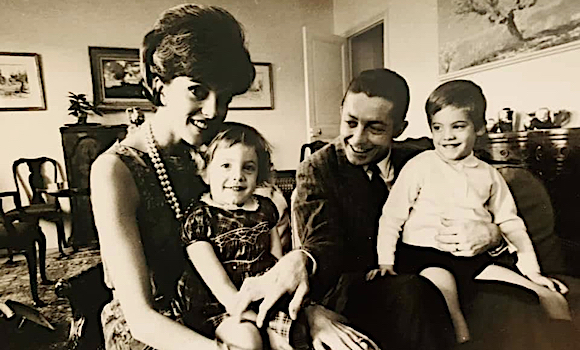
Tony and Shauna Trabert had two children both of whom have had careers in tennis and they explained the importance of the Cincinnati Open salute.
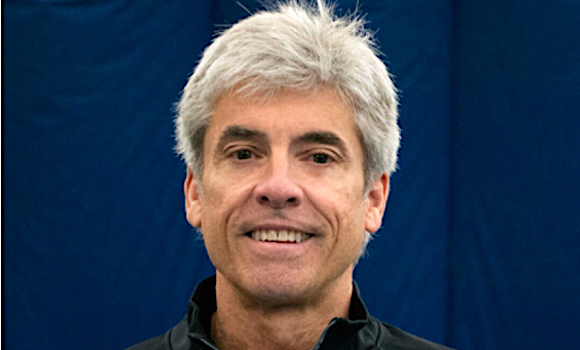
Mike Trabert, Manager of Tennis at the Salt Lake Tennis & Health Club, said, “The Cincinnati Open bestowed great recognition on my dad. I know he would be extremely honored and so proud.
“Although he spent many years living in California and Florida, he never forgot where he came from. His humble beginnings in his beloved Cincinnati. His formative years through elementary school, middle school, Walnut Hills High School, and the University of Cincinnati molded him into the world champion tennis player he became. But more important, the man he became. The three most influential people in his life in Cincinnati were his father Archie, his high school basketball coach, Willie Bass, and his mentor and Davis Cup Captain, Bill Talbert.
“Having a court named for him, at the prestigious Cincinnati Open, in his hometown, is a magnificent honor. He would be immensely grateful.”
Brooke Trabert worked in tennis operations and club management at facilities in the Southern California desert locations such as the La Quinta Resort before moving to Ponte Vedra and becoming Tennis Operations and Events Manager at Sawgrass Count Country Club.
She offered, “To know that Dad will be honored at the Cincinnati Open with a stadium court bearing his name is incredibly special.
“Cincinnati isn’t just another tournament-It’s home. It’s where his journey began, where he first fell in love with the game, and where so many of his dreams took shape.
“Dad taught us the values of hard work, humility and sportsmanship, and consistently giving it your all.
“Watching the city that shaped him honor the legacy he created is something our family will cherish forever.
“He was truly one of a kind and I’m so proud to have called him ‘Dad’”
Postscript…
Having had a birthday at the end of July, it seems I’ve been involved in tennis forever… initially as an ordinary player before transitioning to coaching then working with Tony Trabert at his summer tennis camp in Ojai, California and learning the intricacies of the game. Eventually I became a US Boy’s Junior Davis Cup coach, and all the while pursued a career as a tennis journalist…
Almost daily during the 1970s, when we were not attending tournaments and at home in Los Angeles, we hit and often played doubles on the backyard courts of Omar Fareed, the US Davis Cup team doctor, or Frank Clarke, the President of the Southern California Tennis Association who was Jack Kramer’s lawyer.
He was “Tone or T2…” and I was “Marko…”
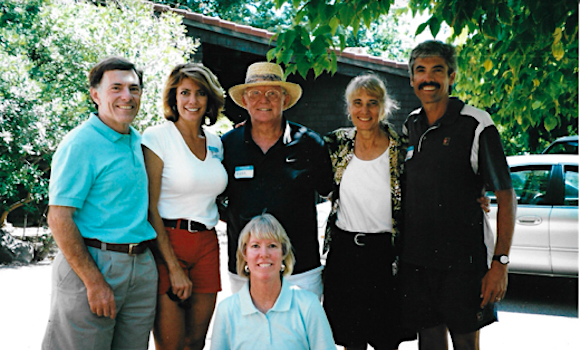
Over the years, thanks to his friendship I experienced firsthand what took place behind the scenes at Roland Garros, The Championships and the US Open, and added to my television broadcast understanding spending time with him in the production facilities at these events…
I also gained international tennis administration and Davis Cup insight and more important thanks to his introductions became acquainted with a library’s worth of the game’s greats including Bill Talbert.
Having been a “wordsmith” for some time, it is still difficult for me to fully describe our lengthy relationship…
There are mentors… but Trabert was much more.
He set a standard. One I am still attempting to realize…
He epitomized fairness, honesty and thoughtfulness. Even more important, he was completely genuine.
He had an aura, a presence that was dynamic.
Even now with a good bit of gray in my hair, he is still my hero.
The Tower of Pisa is iconic and so was he… Which is why it is so fulfilling that the Cincinnati Open recognized Tony Trabert, whose charisma, for so many, remains unsurpassed…
Title photo by Brooke Trabert