
Though they are not in the draw, they are the 2026 US Open’s most formidable doubles team. They will play a critical role in the August 23rd to September 13th pageant taking place at the Billie Jean King National Tennis Center in Flushing Meadow, New York.
As major participants at the last slam of the year, their relationship has generally been ignored.
But it shouldn’t be…
The Non-Profit US Open and Ticketmaster (the Live Nation Subsidiary) are a colossal pairing.
Dominant yet unseeded…
Let me explain…
The US Open announced an abacus-defying US$108 million in player compensation, a 20% increase over 2025.
Champions will receive $5.5 million, while first round participants add $140,000 to their bank accounts, a 27% increase.
Qualifiers receive a minimum of $32,000, a 16% increase.
All doubles winners will receive $1 million per team.
In addition, the new US Open Player Support Program, amounting to $2 million, is intended to assist mid-career and retirement transitions of main draw singles and doubles competitors. The Support Program will be held in escrow until distribution details are finalized.
Being the final Grand Slam of the year, New York always outdoes the other slams, surpassing Australia’s $75 million in player compensation; Roland-Garros’ $75.1 million and The Championships’ $85 million. (The AO, RG and TC figures were based on exchange rates at the time of the tournaments.)
The amounts are made even more daunting because the tournaments aren’t charities, which is why sponsors and partners, television/radio arrangements… and ticket buyers, combine to enrich the players.
Being New York, the US Open’s Secondary Market is the Top Seed…
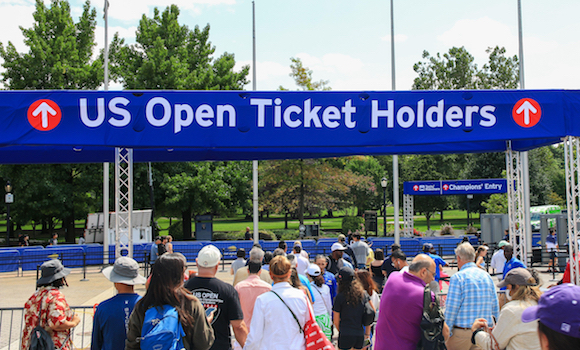
Research reveals a Grounds Pass, if one could be found, was $65 but on the Secondary Market they were, depending on the day, between $237 and beyond $360. But after 6:00 p.m. there will be a “Deal” – a Grounds Pass will be $25.
Initially, seats in the upper levels of Arthur Ashe Stadium started at around $327. Moving to a better location closer to the court required spending $500 to $1236 (above the Luxury Suites) to $2100. Based on available figures, the fee for attending the opening at Louis Armstrong Stadium, was in the range of $466.
“Walking through the gates” calculations found it would be between $288 and $311 to do so… a double-digit increase from a year ago.
In a must-read New York Times article, “U.S. Open ticket prices are skyrocketing, from grounds passes to luxury seats. This is why”, Matthew Futterman and Artur Galocha Vallejo noted, “As tennis has found a groove at the intersection of media, celebrity, sports, culture and high fashion, the popularity of live events has increased in the wake of the Covid-19 pandemic. Sports events such as the U.S. Open have assumed the status of a superstar’s concert, and for many years, a rampant resale market has taken advantage of that popularity.
“The organizers of those events are also recognizing their own lucrativeness. And for the U.S. Open, 2026 is the first year in which that dynamic has aligned with the tournament’s immediate concerns.”
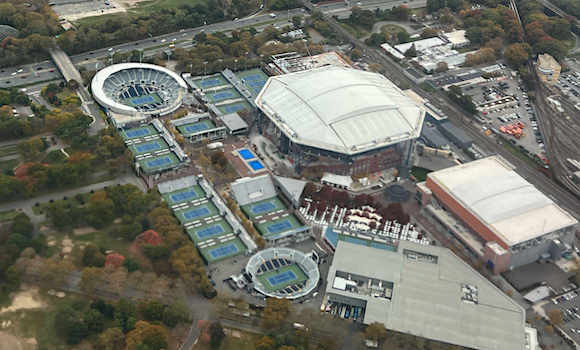
But the article revealed more. “Arthur Ashe Stadium, the highest-capacity arena in tennis, is halfway through an $800 million renovation, which will reconfigure it toward the premium hospitality that the USTA says its most moneyed customers’ demand. At the same time, top players are seeking reforms that will mean that their prize money takes up a bigger proportion of the Grand Slam tournaments’ revenues. And if the organizers of those tournaments want to honor that prize-money increase for the players while keeping the same margins, something has to get more expensive.
“Right now, that something is (paying more dollars for) sitting on the tournament’s biggest court.”
Futterman and Galocha Vallejo importantly added, “The USTA does not control what sellers ask or what buyers pay, though its contract with Ticketmaster allows the USTA a small commission on the resale of tickets. The other three majors have guardrails in place, from enforcing resales at face value to not permitting them at all.”
The online reaction to the new US Open tariffs that the public will heft was strident (and the increases in food and souvenir prices shouldn’t be ignored).
“The U.S. Open is owned by the USTA which is a non-profit. The idea that a day one ground pass is $363 is absurd. It’s actually scandalous…”
“One thing that’s irritating is that the resellers are making so much profit overall, they’ll let tickets go unused instead of lowering prices…”
In the “Going To Pocket” section of a story written about the 2005 tournament, I noted, “A first Saturday Grounds Pass, according to a city hotel concierge, could be purchased for $200, but anyone interested had to take two (which made it very costly for an interested buyer because he didn’t want to leave his wife home)….”
The family-like business relationship between the Non-Profit and the Subsidiary should be scrutinized. Ticketmaster was founded in 1976 and merged with Live Nation Entertainment in 2010, two years after becoming involved with the US Open. Profit has skewed the “Increase-tennis-participation” balance sheet. Revenue is the partnership’s sole focus.
This past April, a federal jury in the U.S. District Court for the Southern District of New York in Manhattan found Live Nation and Ticketmaster liable for operating as an illegal monopoly. The decision is being appealed. In the spring of 2027, the judge will rule on the financial penalties, damages, and possibly breaking up the companies. None of this affects the ticket pricing at the 2026 US Open, but does make the point that “Something is amiss”.
The fact that the final Grand Slam of the year – played at a public facility, organized by a Non-Profit, whose credo is introducing the game to the masses – partners with the world’s biggest ticket Subsidiary is confounding.
The situation leaves tennis fans (whether an individual, a couple or a family) hoping to find a friend or someone who works for a corporation that has the next-to-unaffordable ticket(s) to purchase at a discount.
A more practical approach for devotees would seem to be watching the tournament on ESPN, ESPN2, ABC or the Tennis Channel… thereby not incurring debt thanks to the Non-Profit and the Subsidiary’s impact on ticketing.
Title photo of Billie Jean King’s racket by Budds