For Novak Djokovic, the tennis year began with representing Serbia.
At the United Cup in Perth, Western Australia, and in Sydney – as part of Serbia’s seven player team – he played singles and mixed doubles with Olga Danilović.
Team Serbia progressed to the quarter finals to be defeated by Australia in a clean sweep victory of 3-0.
It was the beginning of a quiet start to the year by Djokovic’s remarkable standards, with the contributing factors of a wrist injury followed by a knee injury.
In Melbourne, he made the semi finals, losing to the eventual champion Jannik Sinner in four sets. A respectable showing for most players, but it was the first time Djokovic had lost a semi at the Australian Open. He arrived with a perfect record of 20-0. And further perfection in an unrivalled 10-0 for finals.
He then lost every tournament he played on his way to Roland Garros – Indian Wells, Monte Carlo, Rome, Geneva.
His luck did not improve at Roland Garros. He gifted a walkover to Casper Ruud when a torn meniscus prevented him taking the court for their quarter final.
In April, he had told the media, “The Olympics have always been a priority for me.”
Yet, he returned after his knee surgery to play on the grass of Wimbledon, requiring an immediate switch to the clay of the Olympic courts at Roland Garros.
Many wondered why he didn’t rest his injury longer, including his wife Jelena. As he told it, she said, “(At) 37 years old, you want to maybe have less risk and prepare yourself for the Olympic Games?”
It turned out that Djokovic played well at Wimbledon and did not aggravate his freshly repaired knee. He played only six rounds to make the final, gaining an unexpected rest day after Alex De Minaur withdrew before their quarter final with an injured hip.
But he again lost in the final to Carlos Alcaraz. Last year their final was a see-sawing five-setter; the 2024 version was a straight sets loss for Djokovic, 2-6 2-6 6-7(4). In his Runner-up speech he pondered becoming his son Stefan’s coach.
But none of it mattered at the Paris Olympics.
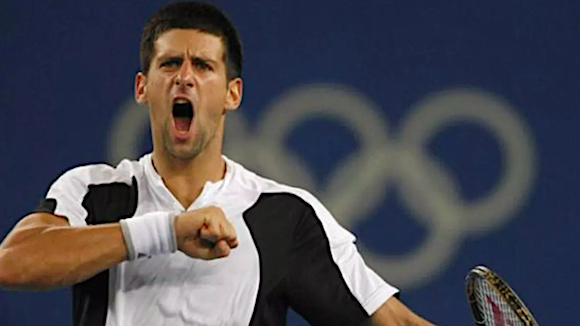
Djokovic made his Olympic debut at Beijing 2008, at the age of 21.
Earlier in the year, he had won his first slam, the Australian Open.
Ranked No. 3 in the world, he faced Rafael Nadal in the Olympic semis. In a tight match not fully reflected in the score line, Nadal won 6-4 1-6 6-4. The Spaniard went on to win Gold over Fernando Gonzalez of Chile.
To capture the Bronze medal, Djokovic took on American James Blake, who had knocked out World No. 1 Roger Federer in the quarter finals. Djokovic seized his medal 6-3 7-6 (4) on the back of brilliant serving.
“I’m very, very happy,” he said. “I mean, to win any medal in the Olympics is a huge achievement for any athlete, I think.
“Not many athletes get a chance to win a medal. But for me, this bronze shines like a gold.”
At London 2012, the Olympic tennis event was held at Wimbledon. Understandably, British fans were overjoyed when Andy Murray won Gold. In a rematch of that year’s Wimbledon final, the Scot defeated a player almost as popular at the All England Club, Roger Federer.
For Djokovic, the tournament had a disappointing outcome. He beat Fabio Fognini, Andy Roddick, Lleyton Hewitt and Jo-Wilfred Tsonga before Murray stopped him 7-5 7-5.
He came fourth, losing to Juan del Potro in the Bronze medal match, 5-7 4-6.
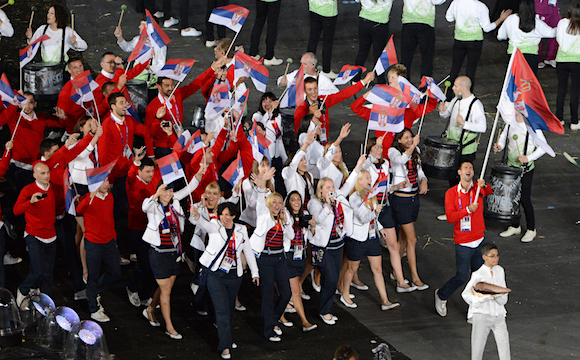
Despite missing out on a medal, a definite highlight for Djokovic at the 2012 Olympics came when he led the Serbian team as its official flag bearer at the Parade of Nations during the Opening Ceremony.
He described the flag bearing role as “an out-of-body experience” and a “huge pleasure and responsibility and honour”.
In 2016, the Argentinian del Potro evolved into Djokovic’s Olympic nemesis.
At this point in his career, the Serb had won 12 grand slams, including the 2016 Australian Open and Roland Garros, and was World No. 1.
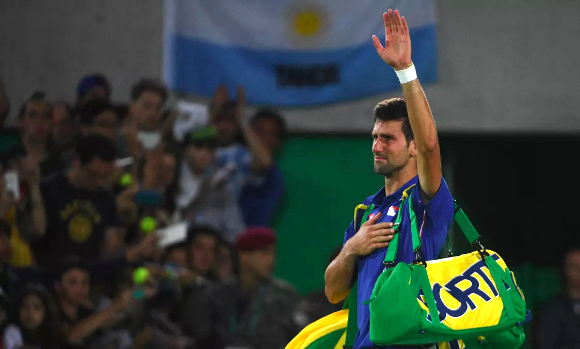
But he lost in the first round to del Potro, who was returning to tennis after a long break due to a persistent wrist injury. It took two hours and 27 minutes for del Potro to win in straight sets, 7-6(4) 7-6(2).
After the match, Djokovic said, “No doubt this is one of the toughest losses in my life and in my career.”
“It’s not the first or the last time I am losing a tennis match. But the Olympic Games, yeah, it’s completely different.”
There was no glory in the men’s doubles either. Playing with Nenad Zimonjić, the pair lost in the second round to 3rd seeded Brazilians Marcelo Melo and Bruno Soares.
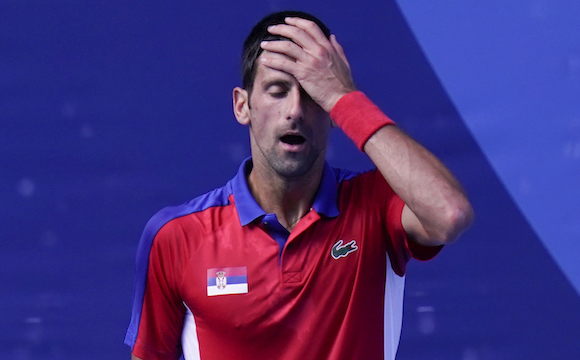
Due to the Covid-19 pandemic, Tokyo 2020 was a misnomer. The event was rescheduled for 2021, without spectators.
Players complained about the stifling humidity and the ITF moved matches to a daily 3pm start.
Again, Djokovic came away without a medal. He cruised through the first four rounds of the singles, losing only 17 games in eight sets.
His match against German Alexander Zverev was something else. Djokovic easily won the first set and broke for 3-2 in the second. At that point, Zverev changed tactics and played more aggressively. His serves were explosive and he pounded winner after winner from the baseline.
Djokovic looked drained of energy as Zverev won 10 of the last 11 games in a 1-6 6-3 6-1 match.
“Tough day, a really tough day. I feel so terrible right now,” was how he summed it up.
He was referring not only to his singles loss, but to his loss earlier the same day in the mixed doubles, with Nina Stojanović.
Some wondered why Djokovic had added mixed doubles to his Olympics schedule instead of focusing solely on singles Gold.
Serbia’s Olympic team coach Viktor Troicki said, “I was against it. The whole team was against it. It was just him. He wanted to play.”
But Djokovic had always played men’s doubles at the Olympics, albeit without success. Only in 2016 did his partnership make it to the second round.
There may have been several reasons Djokovic decided to play mixed doubles in Tokyo.
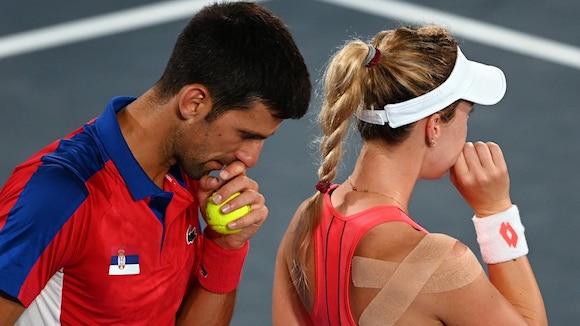
He had won the first three grand slams of the year in 2021 and was a possibility to win the US Open as well, which would have made him the first man since Rod Laver in 1969 to win The Grand Slam. Winning a Gold medal in the same year would give him The Golden Slam, something only Steffi Graf has achieved – in 1988.
Playing both the singles and mixed events – the mixed being a round shorter than the men’s doubles event – effectively doubled Djokovic’s chance of coming away with a Gold.
Alternatively, he may have won two Gold medals and become the first player in history to win The Double Golden Slam.
But it was not to be and Djokovic now had to play two Bronze medals matches the day after playing in two losing semis.
First up was the singles match. In extreme humidity, he battled Pablo Carreno Busta for two hours and 47 minutes. He fought his opponent, himself and exhaustion but went down 4-6 7(6)-6 3-6.
It was Djokovic’s third defeat in two days. “I just didn’t deliver yesterday and today. The level of tennis dropped. Also due to exhaustion – mentally and physically,” he said. “I gave it all, whatever I had left in the tank, which was not so much.”
Djokovic was unable to play the mixed doubles Bronze match. So he and Stojanović gave a walkover to Australia’s Ash Barty and John Peers, and in doing so, declared them the Bronze medallists.
It must have seemed a long time since the Bronze medal was hung around his neck in Beijing.
“I won a medal only once. I mean, ‘only’ – a medal is a medal – but for my standards and expectations and wishes, it’s not an ideal outcome.”
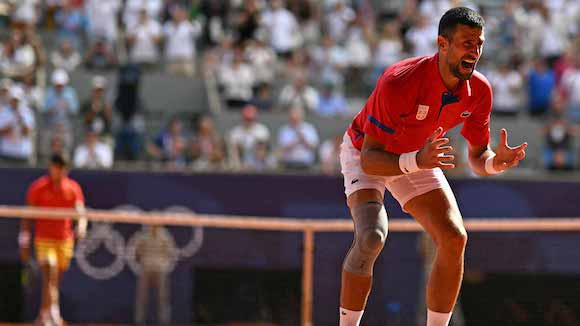
Before the Paris 2024 Olympics commenced, a number of top players announced they would not be competing for their country, or in the case of the Russians, competing as “Individual Neutral Athletes”.
Hubert Hurkacz was recovering from a knee injury incurred at Wimbledon and Holger Rune was nursing a wrist injury. Jiri Lehecka had missed Wimbledon with a back injury and was still not ready to resume playing.
Americans Ben Shelton, Frances Tiafoe and Sebastian Korda all expressed concerns over possible injury due to the quick change of surfaces from Wimbledon grass to the clay of Roland Garros to the coming hardcourt season. Karen Khachanov of Russia gave the same reason for his non-appearance.
Grigor Dimitrov was ineligible to play for Bulgaria as he had failed to represent the country often enough in Davis Cup.
Both Andrey Rublev and world No. 1 Jannik Sinner gave tonsillitis as the cause of their unavailability. Rublev may already have been half-hearted about the idea of playing as a Neutral, but Sinner had expressed enthusiasm about playing at the Olympics.
In June, after arriving in Halle to play (and win) the Terra Wortmann Open, he told WLM Tennis, “The Olympics is a very unique and special moment in my career. It would be the first time that I play there so I’m looking forward to it.
“It’s going to be interesting getting to know new athletes, how they practise and everything. I think the Italian team is going to be quite big so it’s also a huge honour to be part of this team.”
Sinner was initially announced as the No. 1 seed for the men’s singles but after his withdrawal, Djokovic was elevated to top seed. This Olympics he decided against playing any doubles and focus on going for singles Gold.
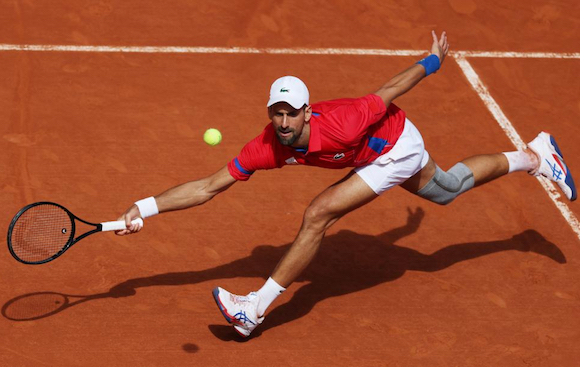
On his way to Gold, he won every round in straight sets – against Matthew Ebden, Rafael Nadal, Dominik Koepfer, Stefanos Tsitsipas, Lorenzo Musetti (the eventual Bronze medallist) and Carlos Alcaraz.
In reaching the final round, Djokovic knew that Paris 2024 would be his best Olympic result as he would at least come away with Silver.
The final with 2nd seed Alcaraz fittingly proved to be his toughest match and lasted two hours and fifty minutes. Both sets had to be decided by tiebreaks and featured clever tactics and jaw dropping rallies.
He played at his best or so close to it, while not allowing Alcaraz to play with his usual creativity.
The 37 year old Serb moved like a gazelle and seized control of both tiebreaks. The first he won with a lungeing stop volley on the first of his three set points. The second, with the assistance of several Alcaraz unforced errors, he claimed with a powerful forehand down the line on the first of four Gold medal points.
The score – 7-6(3) 7-6(2).
“I told Carlos at the net when we finished the final that I was very grateful to him for letting me win the Gold,” said the new Gold medallist. “He’s probably going to have, like, three Gold medals before he retires.”
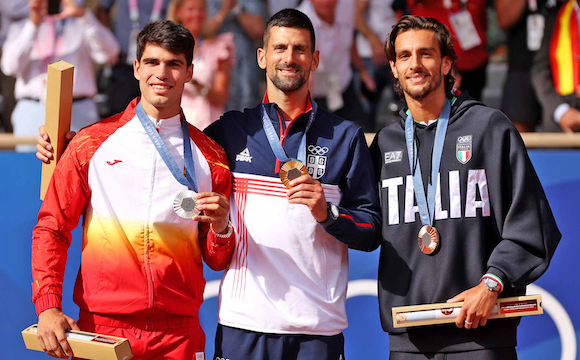
The finalists both wept after the match, obviously for different reasons.
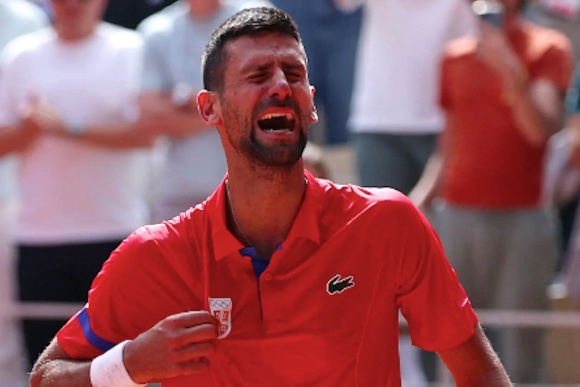
Djokovic knelt on the court and cried, then continued in his chair for a while with his whole body shaking with relief and jubilation.
After displaying the Serbian flag to the crowd, he climbed to his player’s box and embraced his team before weeping in his daughter’s arms.
“I thought carrying the flag at the opening ceremony for my country at the 2012 Olympics was the best feeling an athlete could have until today,” Djokovic said.
“Now at the age of 37 and facing a 21-year-old who is probably the best player in the world right now, winning Roland Garros and Wimbledon back-to-back, I can say that this is probably the biggest sporting success I have ever had.”
While Steffi Graf stands alone with The Golden Slam, Djokovic became the fifth player to have won all four slams in a career plus Olympic Gold – alongside Graf, Serena Williams, Rafael Nadal and Andre Agassi.
And his achievement culminated on his least favourite surface, clay, on which “only” three of his 24 grand slams have been won.
Đoković will next represent Serbia at the Davis Cup later this year.
Title photo by Claudia Greco/ Reuters