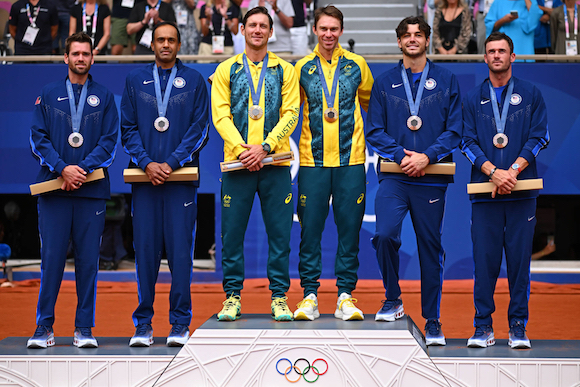
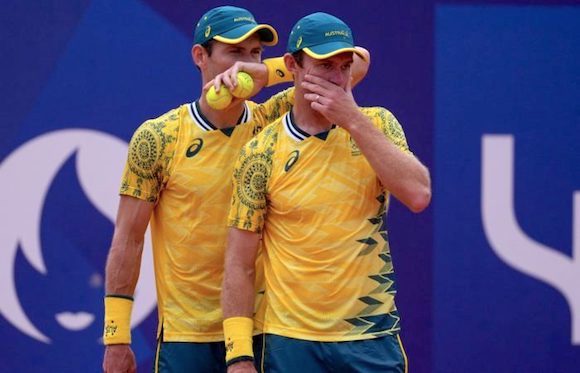
“Our goal is to win gold,” said John Peers of the pledge made when Matthew Ebden called him to request his partnership in the Olympic doubles.
Goal achieved. Of course, most if not all of the 32 doubles teams would have had that same goal. But it was Peers and Ebden who navigated their way through five rounds to the gold medals.
They had played together on the ATP tour only twice, making both finals without winning a title. They also played in a Davis Cup World Group first round in Brisbane. As Australia faced Germany, they contested a close rubber against Tim Pütz and Jan-Lennard Struff. The German pair won 6-4 6-7(1) 6-2 6-7(4) 6-4.
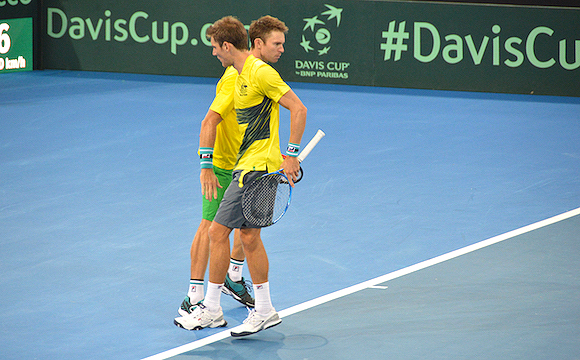
Ebden had made the call to Peers after Max Purcell, doubles champion of Wimbledon 2022 and finalist this year, elected not to play at the Olympics. Purcell’s preference was to play singles for Australia, but his ranking was not high enough to qualify by the cut-off date.
For Ebden, 2024 in Paris was his Olympic debut. He has been world No. 1 in doubles on and off for seven weeks this year, usually partnering India’s Rohan Bopanna.
Ebden’s first grand slam title came back in 2013, when he partnered Jarmila Gajdošová to take the mixed doubles at the Australian Open. He then waited until 2022 for his next slam, joining Purcell for the Wimbledon victory. In January, teaming with Bopanna, he won the Australian Open doubles championship.
Peers had played doubles in Rio 2016 and Tokyo 2020, losing in the first rounds. In mixed doubles, he and Ash Barty claimed bronze in Tokyo after Novak Djokovic withdrew from the bronze medal decider citing a shoulder injury.
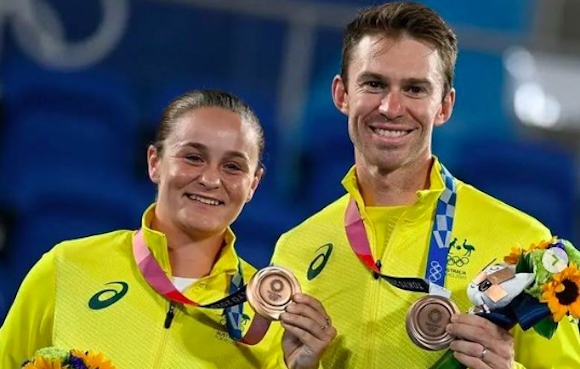
Together with Henri Kontinen, Peers won the 2017 Australian Open, and with Storm Hunter, the mixed doubles at the 2022 US Open.
His career has been a little quieter in the last couple of years. Despite initially being overlooked for this year’s Australian team, he certainly rewarded Ebden’s faith in him in Paris.
Peers was so keen to play the Olympics that he gave up his preferred backhand court on return of serve, so that Ebden, who has the same preference, could take that role in their team.
Before the Australian’s Olympic doubles campaign began, Ebden surprisingly took a detour into the singles event when Holger Rune withdrew. Since there is no qualifying event for the Olympics, there could be no Lucky Losers to slot in for sudden withdrawals. Alternate singles players were taken from the doubles roster.
Ebden hadn’t played a singles match for two years and found himself drawn to play Novak Djokovic in the first round. Knowing he was not expected to win, Ebden thought the match would give him “a feel for the court” before he played his doubles event. Australian team captain Lleyton Hewitt told him, “Do not get injured”.
He won a game in the 53 minute match and said a second farewell to his singles career.
Peers has been a doubles specialist his entire career, never having played a main draw singles match. He last tried to qualify in 2014.
At the Olympics, the two 36 year olds won all their rounds in straight sets up to the final.
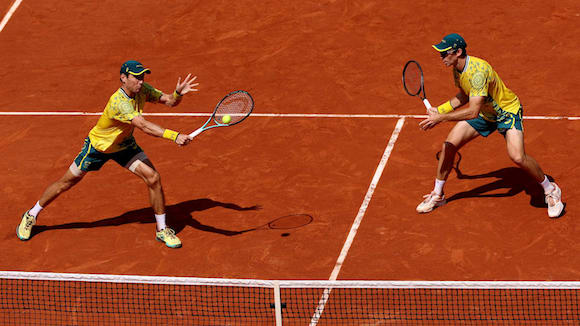
Germans Dominik Köpfer and Jan-Lennard Struff gave them a straight sets double tiebreak quarter final, 7-6(2) 7-6(4). The Australians were elated to get through the tough match.
“They played super well. Dom is seeing the ball like a watermelon. He was zoning, swinging from the hip, left, right and centre,” Ebden said. “And Struffy is one of the best doubles players in the world, he plays huge.”
In the semis, Ebden and Peers faced a couple of top singles players, Taylor Fritz and Tommy Paul. The Americans started playing doubles together as juniors but rarely play the doubles game these days. But they were mentored at the Olympics by one of the best teams in recent history, the Bryan Brothers.
After losing the first set 5-7, USA made far too many unforced errors and fell behind 0-4 in the second.
With Australia leading 5-2, Ebden needed three match points but got it done when Fritz returned a second serve long.
Neither of the Australians had a big serve compared to their opponents but several times held to love with outstanding placement.
Fritz and Paul went on to take the bronze medal for the USA over Czech team Tomas Machac and Adam Pavlasek, 6-3 6-4.
But the other USA entrants in the doubles, 4th seeds Austin Krajicek & Rajeev Ram, reached the final with a guarantee of taking home either silver or gold.
Their match against Ebden and Peers was so tight it took three tiebreaks to determine gold from silver.
Games were on serve in the first set until Peers was broken for 2-4. But Australia broke straight back through a Ram double fault.
Soon enough, Ram held to love to take the USA to a 6-5 lead. Ebden drew the score level and in the ensuing tiebreak saved a USA set point at 5-6, but then hit wide on the second set point for 6-8. Australia had lost its first set for the tournament.
In the next set, Ebden was broken for 1-2, and a great serve out wide from Ram immediately consolidated the break.
Peers later said that after going down a set and a break, he and Ebden kept telling each other “Hang around long enough”.
And they did. Great combining got them the break back against Ram for 4-4. Ebden’s remarkable touch at the net saw them take the lead 5-4 and the set surged on to its tiebreak. Australia went up 4-0, winning the points with superb smashes and volleys. An unreturnable serve from Peers took them to 7-1.
The Olympic doubles format required a first-to-10 match tiebreak, also referred to as a super tiebreak, whenever a match was level at one set all.
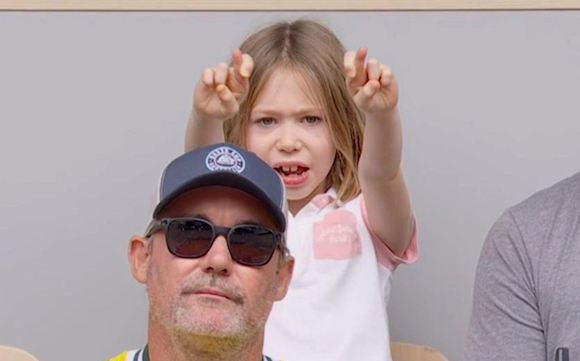
Throughout the match tiebreak, Peers’s daughter Emma pointed her crossed fingers towards the court and whispered affirmations to support her father’s team.
Peers and Ram exchanged double faults for 2-2, before Ebden secured a mini break for Australia, 4-2. The next two points arrived with a smooth serve/volley combination and the gift of Krajicek’s wayward volley.
The sight of Peers scrambling to return two smashes from Ram with perfectly placed lobs must have distracted Krajicek, who hit the third smash of the rally out. Australia was now 7-2. The next three points were on Ebden’s racquet: an error into net, a volley winner, an error out and it was 8-4.
After Krajicek smashed a winner to move to 5-8, Ebden earned Australia four gold medal points. In a stunning solo effort, he served then hit all seven Australian shots in a rally until he forced USA into error.
Australia had earned four gold medal points at 9-5.
The team saw three of those points disappear due to Krajicek’s brilliance and a nervous Peers error.
Peers redeemed himself by seizing the remaining gold medal point with a serve and volley followed by a smash in between the Americans.
Gold to the Australians and silver to the USA, 6-7(6) 7-6(1) [10/8].
Each of the gold medal winners will receive a payment of AU$20,000 from the Australian Olympic Committee, though it’s unlikely the money crossed the minds of Peers and Ebden at the medal presentation.
Speaking to Nine Media, Peers said, “…to come away with [the gold medal] is very surreal. Each match was a dog fight and today we came back from behind and finished off strong.”
Comparing it to his other tennis achievements, Ebden offered, “I think it ranks above anything. I mean, the Olympics is once every four years only. To get a gold medal – just to play is amazing – but to get a gold medal is far and away above anything I’ve ever dreamed of…”
The gold medallists live a street apart from each other in the city of Perth and Ebden added, “We’re going to talk about it until we’re a hundred years old.”
Title photo by ITF