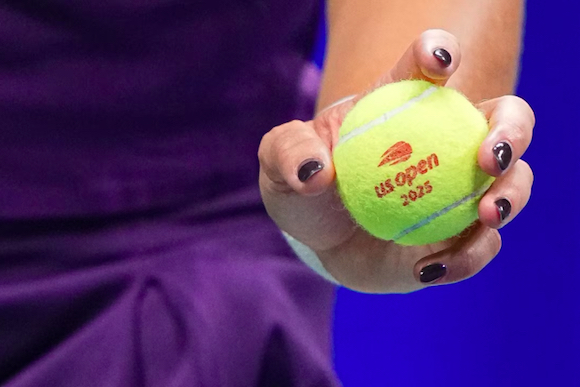
Before looking at the flotsam and jetsam that caught my eye at this year’s US Open, I will begin with “Look Back…” nostalgia.
I remember when the word “Fortnight” was meaningful. Originally its home was The Championships. It had standalone significance before the rest of the majors appropriated the designation.
Since then, the two week showcases have expanded to three week crowd ballooning, money producing pageants… The additional weeks are now titled Opening Week in Melbourne; Les Qualificatifs (which is much better than Qualifying Rounds) in Paris; and Fan Week in New York.
Each major guards its proprietary status… as Deborah Jevans, Chair of the All England Lawn Tennis Club, told Matthew Futterman in a story in The Athletic this past February… “It’s important that Wimbledon maintains its place at the pinnacle of the sport. The other slams are three-week events. We’re a two-week event.”
… which is the reason the AELTC has sought and finally received permission in September 2024 to expand adding 39 grass courts, and an 8,000 seat stadium across the street from SW19 at Wimbledon Park.
(For some reason, Jevans overlooked that the “Qualifying Competition” would be held in Roehampton the week before The Championships began in late June.)
Like the climate, the “Fortnight” has changed dramatically.
Here is a summary of the New York tennis blitz which began August 17th – its first ever Sunday tournament start.
They Said..
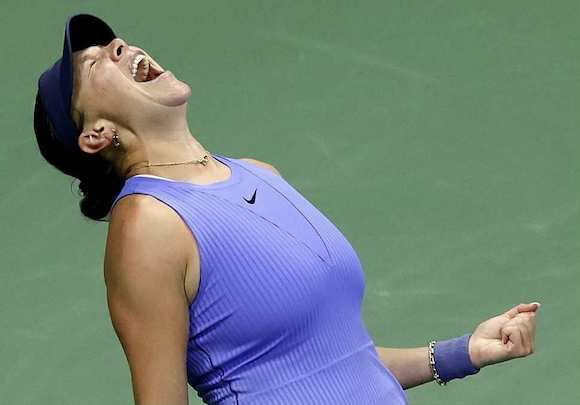
Following Aryna Sabalenka’s Women’s Singles victory over Amanda Anisimova, ESPN broadcaster Sloane Stephens, the 2017 US Open Women’s Singles champion, asked the winner how she was going to celebrate, and Sabalenka gleefully admitted, “Oh girl, we’re gonna drink…”
Anisimova said of her victory over Iga Świątek in the quarterfinals – after her double bagel loss in the final of The Championships in July – “Today is definitely the most meaningful victory I’ve had in my life…”
During her ESPN Women’s Singles final match coverage Chris Evert pointed out that Anisimova was one of the few women’s competitors who could “take the racquet out of a player’s hand…”
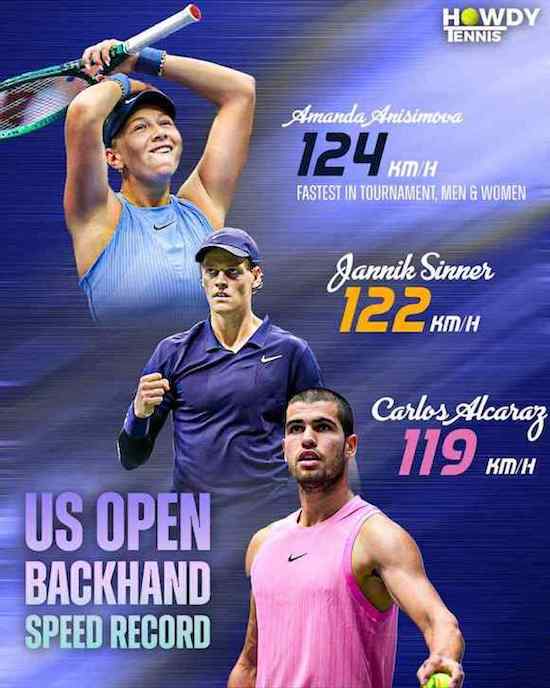
Anisimova won her quarterfinal over Świątek with a net cord… and they regularly happened during matches on Arthur Ashe Stadium, prompting ESPN commentator Pam Shriver to say that the net cord was the tightest she had seen at any of the Grand Slams this year. She added “…one shot hit the net and went up in the air six feet…”
Shriver also noted as the Women’s Doubles finalists warmed up that the sideline benches were too close to the court and players’ safety was at risk.
After winning the Roland Garros Women’s Singles in June, Coco Gauff admitted that the trophy she was given seemed like a “…miniature version… I thought it was going to be like the (US) Open…” The 2023 US Women’s Singles replica, created by Tiffany & Co., that Gauff received for her tournament victory then was actually the first to match the 19 inch size of the original trophy. Incidentally, the men’s champions have always received the 19 inch replica, instead of the 12 inch copy that was given to the women’s winners.
Following her 6-4, 6-4 US Open Women’s Doubles victory, with Erin Routliffe, over Kateřina Siniaková and Taylor Townsend, Gabriela Dabrowski, who last year played through two breast cancer surgeries and radiation treatment, exclaimed, “We rock on!”. The emotions the 2023 US Open Women’s Doubles champions exhibited during the contest, and in all their matches, evidenced how much fun they were having…
When Jannik Sinner met Alexander Bublik at the net following his 81 minute 6-1, 6-1, 6-1 fourth round win, the second fastest men’s match of the tournament, Bublik, who is glib and Sinner’s friend said, “What the f…”
Andrea Petkovic, who retired in 2022, was a 2011 Australian, Roland Garros and US Open quarterfinalist. “Petko”, always a fabulous interview, has now become a “must watch” television commentator and her “Finite Jest” column, an often weekly creation which can be found at andreapetkovic.substack, is on my “Can’t wait to read…” list.
Her September 1st “Monday’s Mirth” was a topic rich and reflective…
“There are some players who are, as we in Germany say, built closer to the water (I love that expression), meaning cry easily. Coco is not one of these players [but she wept during her match with Naomi Osaka]. If she can’t fight off tears, you just know that it’s BAD.
“We walk around the world with a protective layer around us. The more tired we get, the thinner the protective layer becomes… It’s the same with tennis players. All those factions of pressure, the break points and the game points, the 0:30s and the losing of sets, a nuisance throughout the year, suddenly become unbearable. Your brain wants to explode out of your skullcap, you feel angry at the world for putting you through this…
“But it’s not all pain and hardship. Felix Auger-Aliassime played the best best-of-5 match I’ve seen him, nay, I saw anybody, play in months. Balancing the thin line of the highest risk tennis possible, glimpsing the abyss every now and then, but never falling off. Apart from the 8 match points [in a fourth round loss to Barbora Krjickova], Taylor Townsend played a fabulous tournament. Naomi Osaka is backing up her final run in Montréal nicely and has given us a mouthwatering Gauff/Osaka 4th round match.
“In the all Italian match-up between Flavio Cobolli and Lorenzo Musetti the tennis was cut short due to yet another injury. Flavio couldn’t continue after grinding through two 5-setters in a row and had to retire to his friend Lorenzo. I always admired how Italian men show they care through double-hugs, holding each other by the arm and affectionate touches to head, hair and lower back. And both Flavio and Lorenzo ticked all three boxes beautifully when Flavio had to stop…
“One of the best matches of the tournament in terms of quality of tennis happened late last night when Marketa Vondrousova beat Elena Rybakina in a fascinating encounter between one of the cleanest, most perfect ball-strikers in the world in Elena and one of the highest tennis IQs in the world in Marketa. Vondrousova found a way in the third set by changing her game plan one last time with not enough time left for Rybakina to figure it out.
“And in other news: Carlos Alcaraz is janniksinnering. Cruising through his part of the draw, not dropping a single set, looking like he wants to show the world that, he, too, can do consistency at the end of a season…”
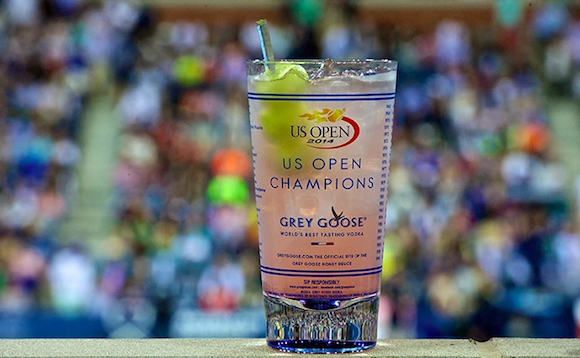
Rory Smith’s September 2nd column in The Athletic enthusiastically portrayed evening activities…
“The U.S. Open loves its night sessions. Lights flash around the upper bowl while pop music blares out of the speakers. Fans load up on Honey Deuce cocktails. And the tennis goes on past midnight and sometimes deeper into the early hours, keeping everyone entertained at the tennis equivalent of a nightclub.”
Worth Remembering…
At the end of a Slam, there are always items which need more than a glimpse…
Caroline Garcia (wildcard recipient) and Petra Kvitová (protected ranking entrant) both lost in the first round of their final Grand Slams. Garcia, 31, played the Open 13 times and reached the Women’s Singles semifinals in 2022, which was her best showing.
Kvitová, the 35-year-old home invasion survivor of 2016, was a New York participant 17 times. The Ladies winner at The Championships in 2011 and ’14, was a US Open quarterfinalist in 2015 and ’17.
Garcia and Kvitová departed, and Emil Ruusuvuori returned… After playing a February Challenger in Spain, the Open was his actual tournament comeback after documenting, in the fall of 2024, his need to take a mental health and injury recovery break. Making his fourth career New York appearance, he lost 6-3, 6-4, 7-6 to Alexi Popyrin in the Men’s Singles first round and teaming with Adrian Mannarino in the Men’s Doubles, came up 5-7, 7-5, 6-2 short against Orlando Luz and Albano Olivetti in the first round. The consensus among the players was that they were pleased that his health had progressed to the point where he could compete again. Before the Open, Coco Gauff, the No. 3 seed, hired Gavin MacMillan, the biomechanics expert noting for transforming Aryna Sabalenka’s serve, to help with hers. During the tournament, Gauff double faulted 37 times in four matches. In her 6-3, 6-2 fourth round loss to Naomi Osaka her forehand went on the accounted for 20 of the 33 unforced errors she made… but only five of those were double faults.
Madison Keys, the No. 6 seed, didn’t play like the Australian Open Women’s titlist, notching 89 unforced errors, including 14 double faults, to 46 winners in her 6-7, 7-6, 7-5 first round loss to Renata Zarazua. Following the match, Keys admitted her nerves became “a little bit paralyzing”.
Daniil Medvedev’s first round “Off Broadway Performance” in the No. 13 seed’s 6-3, 7-5, 6-7, 0-6, 6-4 loss to Benjamin Bonzi depleted his bank account by $42,500 for unsportsmanlike conduct and racket abuse. Qualifier Leandro Riedi, who had earned $644,653 prior to the tournament, collected $400,000 making the fourth round. Janice Tjen, another qualifier, had banked $82,632 in her career before reaching the second round and leaving New York with an additional $154,000.
Tennis Trivia experts pointed out that the four previous times Osaka had reached the quarterfinals of a major, she has gone on to win the tournament. Amanda Anisimova, the No. 8 seed, was 6-7, 7-6, 6-3 superb in the semifinals ending Osaka’s Slam success.
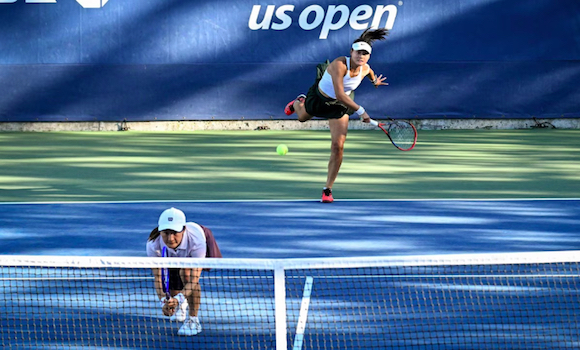
The Open was a horrid event for doubles seeds as this sampling of first and second round departures demonstrates…
Men’s Doubles First Round – Alexander Erler and Robert Galloway defeated No. 1 seeds Julian Cash and Lloyd Glasspool, 7-6, 7-6
Men’s Doubles First Round – Constantin Frantzen and Robin Haase defeated No. 3 seeds Harri Heliövaara and Henry Patten, 6-7, 7-6,7-5
Men’s Doubles First Round – Vijay Sundar Prashanth and Anirudh Chandrasekar defeated No. 8 seeds Christian Harrison and Evan King, 3-6 6-3 6-4
Men’s Doubles First Round – Karol Drzewiecki and Marcus Willis defeated No. 16 seeds Matthew Ebden and Jordan Thompson, 7-6, 6-2
Women’s Doubles First Round – Leylah Fernandez and Venus Williams defeated No. 6 seeds Lyudmyla Kichenok and Ellen Perez, 7-6, 6-3.
Men’s Doubles Second Round – Tomáš Macháč and Matej Vocel defeated No. 2 seeds Marcelo Arévalo and Mate Pavić, 5-7, 7-6, 7-5
Men’s Doubles Second Round – Robert Cash and JJ Tracy defeated No. 8 seeds Simone Bolelli and Andrea Vavassori 6-7, 7-6, 7-6
Women’s Doubles Second Round – Yifan Xu and Zhaoxuan Yang defeated No. 8 seeds Hanyu Guo and Alexandra Panova, 6-2, 6-7,6-3
Continuing the “Look at Doubles…”, Veronika Kudermetova and Elise Mertens, the No. 4 seeds and Ladies Doubles winners at The Championships, scored a rare 6-0, 6-0 first round victory over Cavalle-Relmers and Solana Sierra in 49 minutes. As The Athletic discussed, as bad as the score was, the losing team reached 30-30 and 40-40 in a number of games before surrendering the closing points.
In a shorter first round Men’s Doubles encounter Max Exsted and Cooper Woestendick downed David Goffin and Alexandre Muller 6-0 6-1 in 43 minutes.
But in the women’s event, Shuko Aoyama and Yafan Wang ran the clock out, taking three hours and six minutes to score a 6-7, 6-4, 7-6 first round victory over Hao-ching Chan and Xinyu Jiang, the No. 10 seeds.
Maria Sakkari defeated Tatjana Maria 6-3, 6-2 in a Women’s Singles first round battle of the “Marias…”
From all indications “Time Has Come Today” by The Chambers Brothers wasn’t the theme song of the Open’s second week match scheduling. Bob Larson Tennis News pointed out, “There is a deep absurdity in the scheduling of the US Open’s second week… Teenagers probably have body clocks that tend to function on “late” – “late” to bed and “late” to rise. Adults, on the other hand, tend to be up earlier and generally follow, unlike juniors, an “Early to bed and early to rise” approach… So why did the Open schedule junior matches at the beginning of the day and the matches of the adults later…?”
Commentary “Drone On”…
Having worked as a television and radio commentator at the Slams, I appreciate all that is required to provide listeners with coherent insight concerning what is taking place… I also remember being advised, when on television… “Let the shot tell the story…”
In the US, ESPN provided most of the tournament coverage though ABC carried the men’s final…
Many Open viewers were exasperated by the constant match and experts’ thoughts “Drone Ons…”. Some went so far as to “Mute” the sound.
There were times when those watching were befuddled by explanations of points that had just taken place leaving them asking, “Did the commentators really see the last shot…?”
The speed of the Arthur Ashe Stadium court was the No. 1 seed on the “Blather…” list. The tournament “officially classified” the court as medium-fast…Yet, keeping in mind the super athletic quickness and shot making that was showcased, the number of balls that appeared to be “clocked” that didn’t zip through the court and became extended rallies, was mystifying. Points rarely finished quickly and if they did, it was the result of a ball being hit into an open court, an angled winner or a drop shot. Yet the official court speed Gospel was part of the Sermon preached continually during the tournament’s 15 days…
Imagine…
Borrowing from the gist of John Lennon and Yoko Ono’s 1971 anthem…
Imagine…
Looking forward to attending the US Open Men’s Singles final and the “can’t wait anticipation…” to get inside Arthur Ashe Stadium to soak up the atmosphere.
Imagine…
Standing in line to get through the general security check at the entrance to the Billie Jean King National Tennis Center then spending more time going through the process again…
Imagine…
The stress… resulting from how long the security checks took… the fact the match began more than an hour after it should have… and still missing much of the first set because of the rampant chaos… all before finally reaching your seat…
Imagine…
It was all the result of the appearance by… as John and Patrick McEnroe called him, “A Guy From Queens…”, President Trump, who was the guest of Rolex, a major tournament sponsor.
Imagine…
Being a broadcaster and receiving a USTA “How to do your job…” dictate stating in part, “We ask all broadcasters to refrain from showcasing any disruptions or reactions in response to the President’s attendance… in any capacity, including ENG [Electronic News Gathering] coverage.”
The controlled staging of the US Open Men’s Singles final fittingly magnified how meaningful John Lennon’s “Imagine” sentiments remain…
Finally…
When I first went to Paris in the early 1960’s I stayed with my dear friend Richard and his wife June in their houseboat on the Seine. I had never been outside the US, so they set about lessening my naivety. One of my first experiences was walking down a street and facing what seemed to be a triangle shaped building on a corner. It was startling. I had never seen anything like it before.
The design was an example of Trompe-l’œil, a technique that deceives the eye by creating a three dimensional optical illusion of what exists.
At the end of my “US Open… Mixed Smarmy” story posted on August 15th, I said,
“Only time will tell if the experience was Michelin delectable or “better try something else… Smarmy…”
As Vanessa Taylor and Russell Boxshall wonderfully explained in “Mixed Doubles Gets Turned on its Head but Experience Wins”, the defending champions Andrea Vavassori and Sara Errani won the new Trompe-l’œil version of the US Open Mixed Doubles.
To them and those who have reached the end of “US Open… Said And Done”, I extend a “Ben Fatto”…
Title photo by Garrett Ellwood / USTA