The US Open has been an innovator in Grand Slam tennis.
In 1970, the tournament introduced the tiebreak to ultimately determine the score for sets tied at 6-6. At the same time, they applied the tiebreak to fifth sets, a move made well ahead of the other Slams which still required a two-game advantage in the final set to determine the winner.
In 2018, the US Open was the first Grand Slam tournament to introduce a shot clock to force players to conform to the number of seconds between points allowed by the ATP or WTA.
The tournament has also been an “early adopter”. When Roland Garros changed the format of the doubles event in 1990 so that all rounds were reduced from best of five to best of three, the US Open was the next Slam to make the move.
For its 2001 tournament, the Australian Open implemented a match tiebreak (aka super tiebreak) to replace the third set of a mixed doubles match. The first team to 10 points with a margin of at least two points would be the winner. The US Open was the first Slam to follow suit.
The practice of “no-ad” scoring, meaning games do not use the two-point Advantage system but are won by one point after deuce, was introduced by the ATP in 2006 and adopted for the mixed doubles at the US Open by 2016.
But no change has been as extreme as the “remix” for the 2025 mixed doubles event.
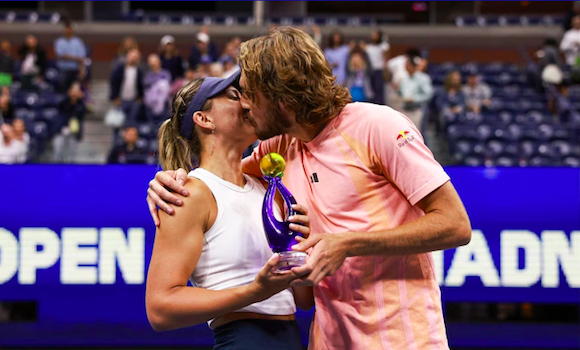
Photo: US Open
Last year’s “Mixed Madness” exhibition at the US Open was undoubtedly the inspiration behind the new mixed doubles format. It took place during Fan Week and featured “fan-favorites” playing set-long matches. At the time, the exhibition was described as the inaugural Mixed Madness, but there is no second edition of the event in 2025. Instead it has morphed into a mixed doubles Grand Slam.
This year, the mixed doubles Slam takes place over two days of Fan Week. The draw is halved from 32 teams to 16. Of those 16 teams, the eight “qualifying” teams are accepted on the basis of their combined singles ranking. A player’s doubles ranking is no longer relevant to their participation or seeding in the mixed doubles.
The remaining eight teams are granted wild cards.
One of the most drastic changes is that – aside from the final – the event will use the Fast4 format. So, the first team to reach four games wins the set. If the score gets to 4-4, a tiebreak will be played. At a set each, a match tiebreak will be played.
Never before has a Grand Slam tournament used Fast4. As well, no main tour tournament uses the format. Fast4 was devised by Tennis Australia for use in exhibition matches. Although the ATP has used Fast4 since 2017 for its NextGen tournament, NextGen is classified as an exhibition.
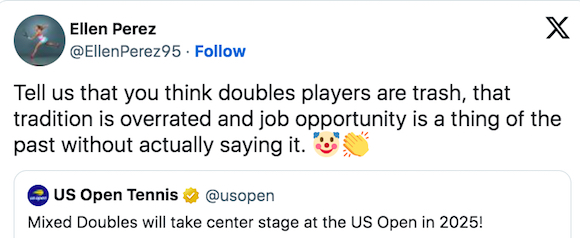
From February, when these changes to mixed doubles at the US Open were announced, strongly opposing views have been expressed. While the changes have succeeded in generating much buzz about the possible pairings of top singles players, many fans and commentators have been scathing about the gutting of Grand Slam tradition.
US Open tournament director, Stacey Allaster, rejected the views of cynics. “Let’s be absolutely crystal clear, this is a Grand Slam championship. It is not an exhibition.”
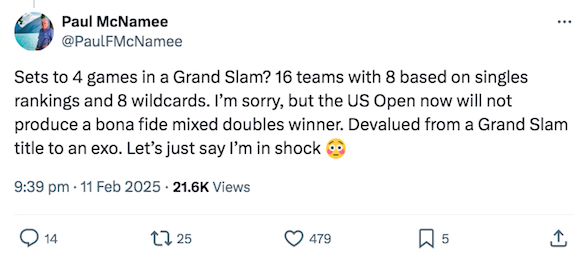
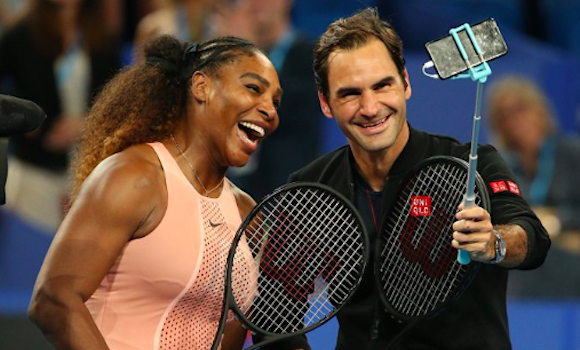
Former No. 1 ranked doubles player Paul McNamee won a mixed Slam with Martina Navratilova, as well as three men’s doubles Slams. He devised, and ran for many years, the original Hopman Cup that ran in Perth annually for 31 years. Mixed doubles combinations in the event included Steffi Graf and Boris Becker; Martina Hingis and Roger Federer; Hana Mandlíková and Pat Cash; and Ana Ivanović and Novak Djokovic. The last Perth Hopman Cup featured a final with Serena Williams and Roger Federer playing on opposite teams.
Before the reintroduction of mixed doubles to the Olympic Games in 2012, the organisers requested and reviewed footage of the exciting exchanges from the mixed matches at the Hopman Cup.
McNamee’s negative views on the US Open’s new mixed doubles format have been echoed by several doubles/mixed specialists who, despite being highly successful in their field, will now be excluded from the opportunity to win a Grand Slam and earn the accompanying prize money.
Some players who initially entered the mixed doubles only to be overlooked can feel especially hard done by. All these rejects have won doubles Slams – Hsieh Su-wei (nine, including two mixed); Desirae Krawczyk (four mixed); Gabriela Dabrowski (three, including two mixed); and Jan Zieliński (two mixed).
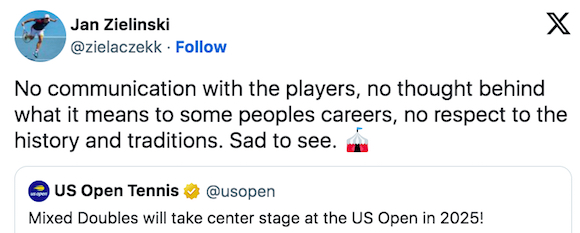
Allaster has also stated, “We’re sympathetic to the doubles specialists who don’t like this change… (But) we know that when fans see top players competing… this is going to inspire more fans to not only attend but to play tennis.”
The reigning champions, Sara Errani and Andrea Vavassori, issued a joint statement: “In the last few weeks we received the news that the US Open mixed doubles tournament will be completely turned upside down, cancelled and replaced with a pseudo-exhibition focused only on entertainment and show.
“We see it as a profound injustice that disrespects an entire category of players.”
The Italians secured a wild card to defend their title, although that means they will be unseeded.
Last year, they shared $200,000 to go with their trophies but this year, should their repeat their win, they will be splitting $1 million, and for much less work.
The bottom end of the prize money is $20,000 for teams who lose in the first round.
The increased prize money is one welcome change for the event. But where does it leave the women’s and men’s doubles champions? They will also receive $1 million to share – up $250,000 from last year – but in all probability will work harder for it, playing under the usual doubles structure not Fast4.
By 21 July, 26 teams had entered the mixed doubles. These were culled by the organisers down to eight direct entry teams and five wild card selections with room for three more.
The organisers’ experiment with the draw caused them many headaches as they were forced to continually reorganise the teams.
Wisely, the promotional poster for the mixed doubles added a fine print disclaimer at the bottom edge, “Players subject to change”.
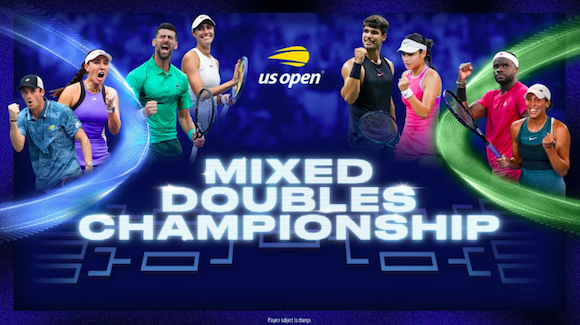
For various reasons, along the way several players dropped out, including Aryna Sabalenka, Donna Vekić, Tommy Paul and Grigor Dimitrov. Each time it happened, a reshuffle was required. The most affected player was Jack Draper, who paired with Zheng Qinwen, then Paula Badosa and eventually, Jessica Pegula.
Jannik Sinner was a very last minute drop out, having retired with a fever from the Cincinnati final at 0-5 and gifting the title to Carlos Alcaraz. Sinner was originally selected by ranking, but when his partner Emma Navarro dropped out, he was quickly paired with Kateřina Siniaková who until then had been rejected for a wild card, despite having won 14 Grand Slam doubles titles, including one mixed, plus an Olympic mixed gold medal. Obviously, the lateness of Sinner’s withdrawal meant Siniaková still didn’t get to play at all. They were replaced by the impromptu wild card team of Danielle Collins and Christian Harrison, who both got the call up on the morning of Day 1 of the event. Harrison was an official Alternate and is currently ranked world No. 17 in doubles.
Jasmine Paolini has won a Slam and Olympic gold in women’s doubles but, having entered the US mixed with fellow Italian Lorenzo Musetti, got the chop in the first cuts in July. When other teams dropped out, they made direct entry. Subsequently, Paolini withdrew after making the final in Cincinnati. Musetti hastily formed a partnership with Caty McNally, though she had never actually entered the event. McNally often plays doubles but in singles is currently ranked No. 103, so for Musetti this new pairing meant he moved from direct entry to a wild card team.
Gael Monfils had also never entered the event but within two days of the starting date, became the partner of Naomi Oaska. She had previously been waiting with Nick Kyrgios to see if they would be granted a wild card, but Kyrgios was a late scratching from the waiting list due to injury.
There will regularly be disgruntlement around the awarding of wild cards for Grand Slam tournaments, but this event has been particularly haphazard.
Direct entry teams:
- Jessica Pegula and Jack Draper
- Iga Świątek and Casper Ruud
- Elena Rybakina and Taylor Fritz
- Amanda Anisimova and Holger Rune
- Belinda Bencic and Alexander Zverev
- Mirra Andreeva and Daniil Medvedev
- Madison Keys and Frances Tiafoe
- Karolina Muchová and Andrey Rublev
Wild card teams:
- Olga Danilović and Novak Djokovic
- Emma Raducanu and Carlos Alcaraz
- Danielle Collins and Christian Harrison
- Taylor Townsend and Ben Shelton
- Sara Errani and Andrea Vavassori
- Venus Williams and Reilly Opelka
- Naomi Osaka and Gael Monfils
- Lorenzo Musetti and Caty McNally
On the question of whether the other Grand Slam tournaments will follow the US Open’s lead, Tennis Australia has announced, “…we have no plans to change the current format of the mixed doubles championship” adding that the event is already popular at the Australian Open. Wimbledon certainly won’t make such changes in the foreseeable future, being always the most reluctant Slam to tamper with tradition. As for Roland Garros, a decision could depend on the reception of the new US Open formula once the dust has settled.
Tennis fans love to compare players’ Grand Slam tallies and engage in furious “The Greatest of All Time” debates. How does this year’s mixed doubles title equate with those of the past, or does the new format not matter as there have been many changes in tennis over the decades?
In the record books, will the 2025 US Open mixed doubles have an asterisk next to it?
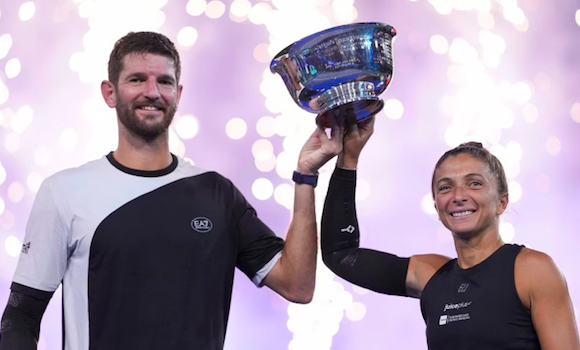
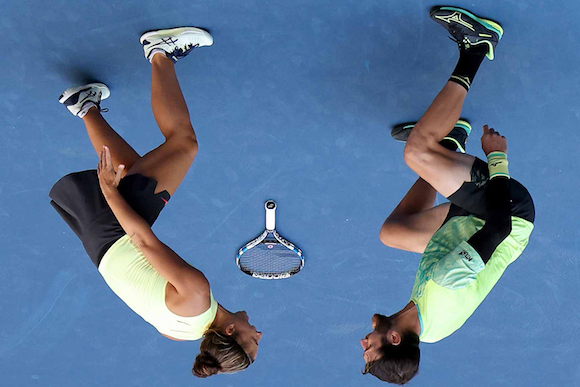
Title photo of Andrea Vavassori and Sara Errani winning the 2024 US Open mixed doubles by ATP
Update… the next day
On the second and final day of the mixed doubles tournament, Arthur Ashe Stadium was packed with 23,000 fans.
First up was the semi between top seeds Jessica Pegula / Jack Draper and 3rd seeds Iga Świątek / Casper Ruud. Much of the match was cross court groundstroke rallies between two players, rather than the net person intercepting to poach points.
The fact that the players were taking part in the new Grand Slam-lite format did not affect their competitiveness. In the first set, Świątek challenged Pegula’s smash, saying her ball contacted the racquet as she leaned over the net into Świątek / Ruud territory. Pegula promptly said that if that was correct, she would challenge what she suspected was a double bounce from which Świątek hit a shot. But the video review showed Pegula’s smash was legal.
Ruud got his groove going in second set, especially at the net supporting Świątek’s serve.
At a set apiece, the tournament needed its first match tiebreak. Pegula / Draper started well for 3-0. She had been the steadiest player in all her matches in the mixed event and the leader of her team. They got to 8-4 as Świątek double-faulted, before Ruud lifted again while, surprisingly, Pegula’s form dropped off. After the last six points went to Świątek / Ruud, they looked pleasantly shocked to have won. It took them 85 minutes, the longest match of the mixed tournament so far, to win 5-3 3-5 [8-10].
The second semi pitted the All-American team of Danielle Collins and Christian Harrison against Italian defending champions Sara Errani and Andrea Vavassori. In other words, a team who’d never played together before yesterday and a team which has won two mixed doubles Grand Slams.
Collins / Harrison managed some good play but were outclassed by the unseeded but revved-up Italians. Vavassori was fast as lightening at the net and Errani’s chipped returns mainly worked, for them to win 4-2 4-2.
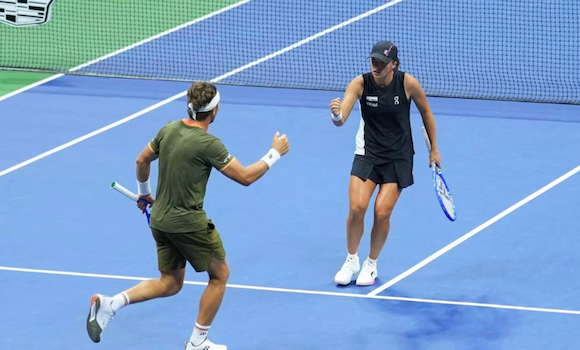
The final started promptly afterwards, with Errani / Vavassori getting only a ten minute break. Nonetheless, they went up 4-1 in 16 minutes. Prior to the final, that would have meant they won the first set, but in this remodelled mixed, the ultimate match was first to six games per set. So, the set ended in favour of Errani / Vavassori at 6-3.
In the second set, Świątek was broken despite her partner’s support. They were unable to break back via Errani’s serve due to their own three errors, so the score became 5-3 against them. Ruud held to love, then his team broke Vavassori for the the first time, as he served for the match. Świątek / Ruud then went on to take the set, 7-5.
The Italians raced out to 3-0 in the match tiebreak and held the lead to 8-4, when some spectators would have been wondering if Świątek / Ruud could repeat their effort of the semis, coming back from this scoreline to take the match.
They won the next point with a brilliant Świątek serve but then watched as their opponents surged to 9-5 and four match points. Having served a fault, Errani then resorted to an underarm second serve but lost the point. Her team still held a trio of match points. In the next one, at the end of a thrilling rally, Świątek dropped to her knees trying to get the ball back but couldn’t.
The championship match was ninety-two minutes of exciting topsy-turvy play that concluded at 6-3 5-7 [10-6].
The crowd thinned considerably for the trophy presentation, perhaps because it was almost midnight. But it wouldn’t have mattered to the champions. The jubilation of Errani and Vavassori would partly have been mixed with relief that they had proved their point. Prior to the revamped competition beginning, they had issued a joint statement saying, “We also play for all the doubles players who cannot compete at the mixed doubles tournament here. We try to do our best.”
In her speech, Świątek told the winners, “You proved that mixed doubles players are smarter technically than singles players.”
Of the champions, Vavassori spoke first, “We saw today that doubles is a great product. And I think also in the future we need more marketing, more visibility.”
More direct in her comments, Errani dedicated the win to “the doubles players who couldn’t play this tournament. This one is for them”.
All four players acknowledged the capacity crowd that had turned out and created a special atmosphere.