In an ancient age when I played competitive doubles, it was immediately apparent that to have fun, I needed to find a partner with whom I got along and more important, one who protected my weaknesses…
In mixed doubles, my approach expanded because of the confused logic of the time… The “hit everything at the woman and hit it hard” tactic was foolhardy because every one of my partners took lessons from a male teaching professionals… so they were used to having tennis balls “cannoned …” at them.
Since my shot making attempts were aggressive… featuring spectacular winners imbalanced by a “spray of shots…” around-the-court errors, my mixed doubles partner played within herself which gave us an opportunity to win… in short, she was the better player, and I was solely “a hitter…”.
These recollections, along with last year’s unexpected championship finalists, led to the crafting of this appreciation story.
In 1887, the US National Championships was the first of the Grand Slams to stage a Mixed Doubles competition. Roland-Garros was next in 1902. The Championships debuted Mixed Doubles in 1913, the same year that Ladies’ Doubles became one of the contested events.
Australia made it a quartet in 1922… but as the Australasian Mixed Doubles Championships, which became the Australian Mixed Doubles Championships in 1927. John Hawkes and Esna Boyd were the first winners and were still formidable, claiming the new name title five years later.
Jean Borotra, the “Bounding Basque” who was one of the fabled “Les Quatre Mousquetaires”, became the first non-Australian winner when he teamed with Daphne Akhurst Cozens in 1928.
Harry Hopman and Nell Hall Hopman made tournament “Husband-Wife” history winning in 1930. The Hopmans were also champions in 1936, ’37 and ’39 and were finalists in ’40.
Jack Crawford and Majorie Cox Crawford duplicated the family success with victories in 1931, ’32 and ’33, after being finalists in 1929 and ’30.

The first all-Australian Mixed Doubles final took place in 1967 when Owen Davidson and Lesley Turner defeated the defending champions Tony Roche and Judy Tegart 9-7, 6-4.
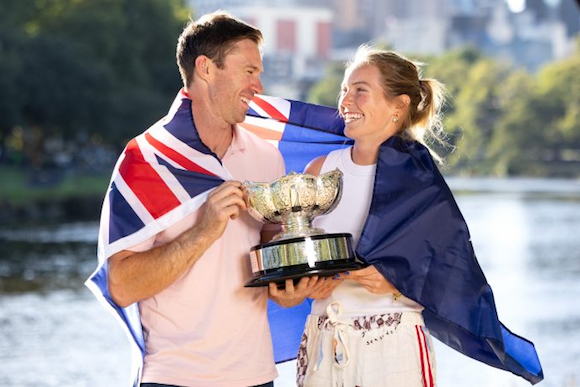
That quartet had “Name status” at home and internationally… which made the 2025 Australian Open Mixed Doubles final truly enchanting. The participants were not well known, excepting perhaps Peers who won Olympic gold for Australia several months before. They were event wild cards and obviously unseeded but John Peers and Olivia Gadecki’s 3-6, 6-4, 10-6 victory over John-Patrick Smith and Kimberly Birrell had “Standalone…” appeal.
Both Peers and Smith were 36-years old, and played intercollegiate tennis in the US. Peers began at Middle Tennessee State University then finished at Baylor University. Smith attended the University of Tennessee and in his four-year career became one of top college players in the country.
At the AO in ’25, Birrell was 26… and at 22, Gadecki was the youngest of the group.
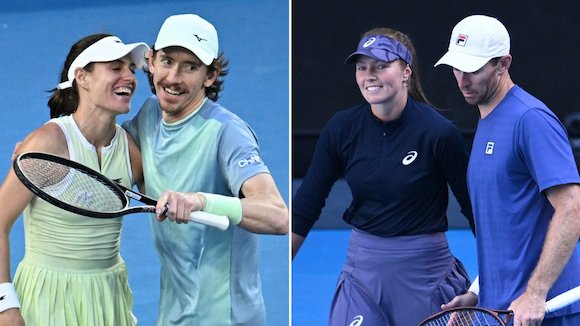
All four had received wild cards at previous AOs either in the singles, doubles, mixed or the qualifying.
At the AO 2013 Peers and Smith were wild cards… playing their first Grand Slams and earning their first victory at a major, upsetting Mariusz Fyrstenberg and Marcin Matkowski, the No. 8 seeds from Poland, 6-4, 6-7, 6-1. They lost their second round contest.
Peers teamed with Storm Sanders (now Hunter) for the 2017 US Open Mixed Doubles trophy, then earned home acclaim winning the 2022 AO Men’s Doubles title with Henri Kontinen.
In 2021, Smith scored two tournament wild card quarterfinal successes… reaching the Last 8 in Men’s Doubles with Matthew Ebden and the same spot in the Mixed Doubles with Astra Sharma, a former Vanderbilt University star.
Gadecki had a memorable wild card AO Mixed Doubles debut making the semifinals in ’23 with Marc Polmans, and the next year teaming with Peers for a Last 4 stop.
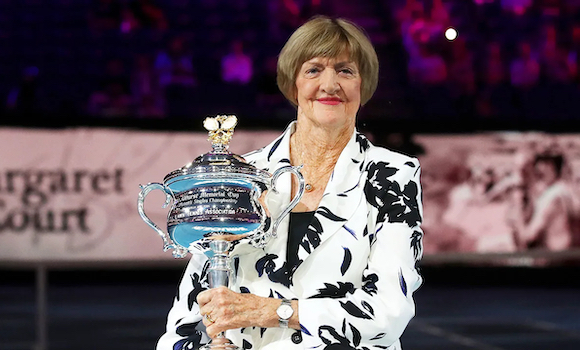
Margaret Court is a Mixed Doubles legend at the Australian Open with four titles, including in 1963 when she swept the table, winning all the majors with Ken Fletcher. Court won The Mixed Grand Slam again in 1965.
Nancy Bolton and Colin Long were also four time winners.
Between 1970 and 1986 the Mixed Doubles was abandoned. Once the tournament date changed from December to January of the next year, it revived.
During the event’s absence, the tournament had not been held in high regard, resulting in the designation the “Poor Man’s Major” or the “Struggling Slam”. Many players skipped traveling “Down Under…” because the courts and practice facilities, at the White City Stadium in Sydney then at the Kooyong Lawn Tennis Club in Melbourne, were not Grand Slam quality. The meager prize money and the complexity of making the trip, along with the tournament dates late in the year, entrenched the “It’s Not worth it” feeling.
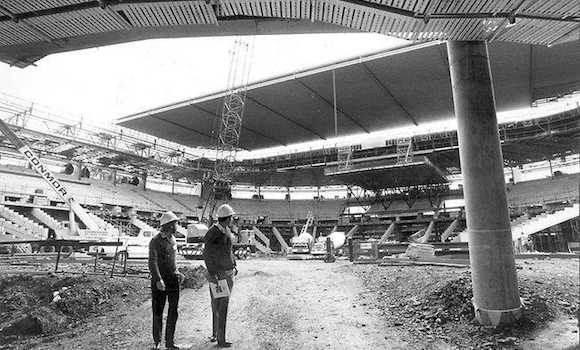
Mixed Doubles returned in 1987, when the tournament became the first major of the year by moving from December to January. While this change of dates was helpful, the transition from grass courts to hard courts a year later, which came with the move to Flinders Park (now Melbourne Park), was both meaningful and dramatic.
Paul McNamee, two-time former Men’s Doubles champion in Melbourne (and a Men’s and Mixed titlist at The Championships), created a resurgence while serving as Australian Open Tournament Director from 1995 to 2006. Thanks to his incisive management, prize money increased as did player amenities. The grounds expanded and critically the “Welcoming…” tournament attitude made it a calendar “Must…”
After being astonished last year, watching 8,000 miles away from Melbourne in my Southern California home, I look forward to the 2026 Australian Open Mixed Doubles… and hope that it will be as intriguing as the 2025 championship.
Title photo of John Peers and Olivia Gadecki in 2025 by Tennis Victoria