
Before Wimbledon began, not many pundits or punters predicted that Barbora Krejčíková would win the singles championship.
The odds of her winning were 125-1. No Wimbledon champion in the last 50 years had longer odds for a win.
Despite just making the list of 32 seeded players at No. 31, she defied the odds.
Of all the other seeded women, only two, Jelena Ostapenko at 13 and Emma Navarro at 19, made it as far as the quarter finals.
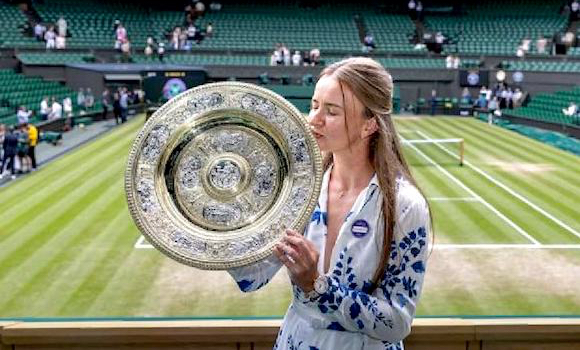
On her path to the final, Krejčíková did not face a seed in the first three rounds.
In the first round, her form did not suggest she would go on to become champion. She needed three hours and 14 minutes to overcome Veronika Kudermetova. After seven double faults and 43 unforced errors, Krejčíková managed to win 7-6(7) 6-7(1) 7-5.
Next was another tight match. Against Katie Volynets she again struggled, another seven double faults plus 35 unforced errors. As in her previous match, Krejčíková won the six break points necessary for a 7-6(6) 7-6(5) result, though Volynets won three more points in the just over two hour match.
Krejčíková’s opponent Jessica Bouzas Maneiro retired with a back injury during their third round match, leaving behind a score of 6-0 4-3 in favour of the Czech. Bouzas Maneiro had knocked out defending champion Markéta Vondroušová in the first round.
The players Krejčíková faced in the following four rounds were all seeded above her. She managed to reduce her errors and defeat 11th seed Danielle Collins with 20 winners and five aces, 7-5 6-3.
Thirteenth seed Jelena Ostapenko had cut a swathe through her opponents until she met Krejčíková in the quarters. Her four matches had been all in straight sets, losing only 15 games.
Ostapenko seemed surprised by Krejčíková’s level of play. She was unsettled as she remonstrated with her player’s box and gestured at her coach Stas Khmarsky to leave.
Krejčíková was close to her best, serving well, including five aces. Since Ostapenko sticks mainly to pounding the ball from the baseline, Krejčíková could not move forward often. But she won all three of her excursions to the net.
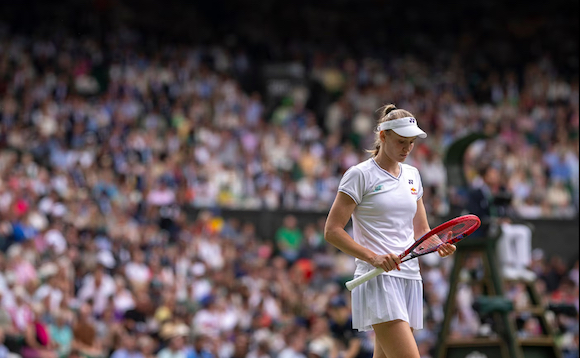
One of the favourites to win Wimbledon this year was 4th seed Elena Rybakina, the champion in 2022. And the Kazakhstani had a fairly easy route, not losing more than four games in a match excepting a three-setter against Laura Siegemund.
Her semi against Krejčíková was a little flat to begin with, as much of the crowd had not yet returned after the long semi between Jasmine Paolini and Bad Homburg finalist Donna Vekić.
Krejčíková was sluggish, perhaps as the day before had started with the 100 minute match with Ostapenko, which was followed shortly afterwards by a doubles match with Laura Siegemund; a close loss to Gabriela Dabrowski and Erin Routliffe who won 6-4 6-7(7) 6-4.
The doubles match lasted two hours and 49 minutes and finished at 8pm, after which the players had media duties.
So while Krejčíková waited to get her mojo back, Rybakina raced out to a 4-0 lead.
Suddenly, Krejčíková snapped out of her torpor and broke for 1-4, though she couldn’t recover the set. Rybakina closed it out for 6-3.
The Czech made a much better start in the second set. On display was the all-court craft that makes her such a great doubles player. Although she doubled faulted on her fifth set point, a couple of points later, thanks to two Rybakina errors, she reached 6-3 to level the match at one set all.
As Krejčíková later described it, “During the second set, somewhere in the middle, I was getting my momentum and when I broke her, I didn’t want to leave the zone”.
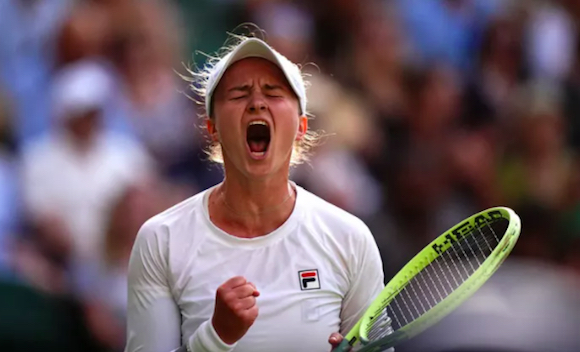
The third set was on serve to 3-3 when Krejčíková got an easy break, which looked like it might be reciprocal as she went down 0-30 in the following game, but she held for 5-3. Rybakina served her fourth ace to hold.
Krejčíková secured a love game, the set for 6-4 and the match with a remarkable angled smash that Rybakina touched with her racquet though hit long.
Rybakina hit 38 winners and eight aces but the flipside was 37 unforced errors.
After the match, Krejčíková was surprised when reminded that she had played her fellow finalist Paolini in the qualifying of the Australian Open in 2018, for a win of 6-2 6-1. It was their only previous meeting.
In terms of Paolini’s career progression, 2018 is a long way from her form this year.
She exited in the first round of Wimbledon the past three years and was knocked out in qualifying three times before that. Now she was in the final, after making the Roland Garros final in June.
Prior to 2024, Paolini’s grand slam record stood at a total of four wins, 16 losses. So far this year, after her semi, the tally was 15 wins, three losses.
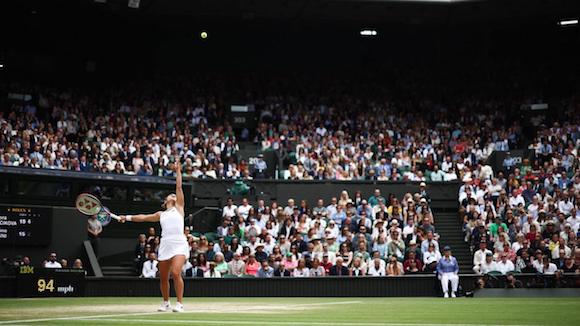
To make the Wimbledon final, Paolini took advantage of a favourable draw and had a large dose of good fortune against 12th seed Madison Keys in the fourth round. At 3-6 7-6(6) 5-4, Keys received a nine minute medical time-out after a groin injury that hampered her movement. The American had led 5-1 in the third set, but Paolini drew level at 5-5.
Keys tried to continue and won a point with a flashing backhand but couldn’t move to return serve on the next point. Tearfully, she retired from the match.
In the quarters, Paolini brushed past Emma Navarro 1 and 2, before playing the longest women’s semi final in Wimbledon history. In two hours and 51 minutes she defeated a valiant Donna Vekić, 2-6 6-4 7-6(10-8). Vekić played so well – her laser forehand was brutal – but she appeared to be suffering towards the end of the match.
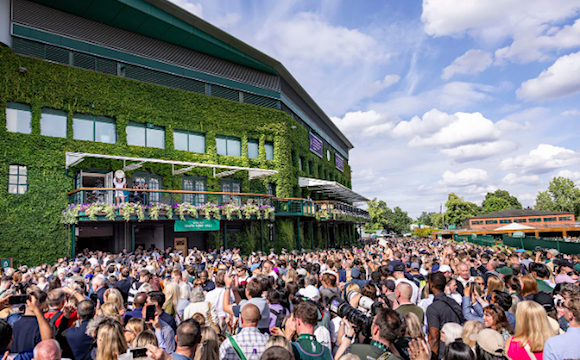
So, two 28 year olds faced off in a first Wimbledon final for both. The first set had the crowd oohing and aahing at Krejčíková’s ball-striking and Paolini’s retrieving. Krejčíková achieved the 6-2 score partly through serving at 92% of first serves.
Errors infiltrated the second set as Krejčíková’s serving lost its accuracy, including consecutive double faults, and her forehand went feral. The score was reversed; Paolini 6-2. The Italian’s confidence had grown and in the third set she won the first game to love. Games then proceeded on serve until she double-faulted to give Krejčíková the break for 5-4 and the chance to serve for the championship with new balls.
In that last suspenseful game, Paolini created a break point but was thwarted by a determined forehand winner down the sideline. There were four deuces and three championship points. On the last, Krejčíková delivered her trademark sliced serve out wide. Paolini’s return was well out of court and she jogged to the net to offer congratulations. She could be proud of the final and can put behind her losing 2 and 1 in the Roland Garros final.
After blowing a kiss to the heavens for the late Jana Novotná, her one-time coach, Krejčíková made the traditional climb to her player’s box. Once there she started by patting the shoulder of the opposition coach who was applauding her.
When she was handed the Venus Rosewater dish as the winner of the tournament, she hesitated to lift it in victory; looking at it in disbelief. Although just a little over two years ago Krejčíková was the No. 2 singles player in the world, injuries had made it a long road back to slam success.
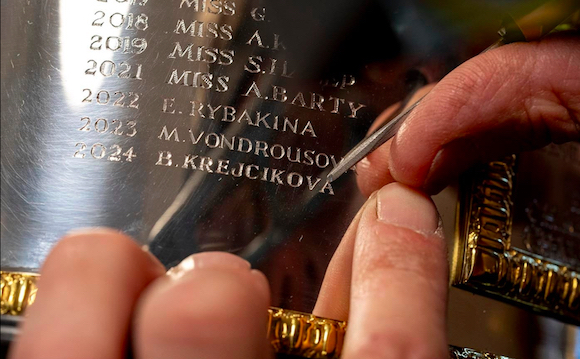
Asked what her win would mean for the people back home in the Czech Republic, she replied, “I think nobody really believes it. I think nobody believes that I got to the final and I think nobody’s gonna believe that I won Wimbledon. I mean. I still cannot believe it. It’s unbelievable. I mean, just two weeks ago I started here and I had a very tough first match three hours 15, winning 7-5 in the third set.
“And I wasn’t really in good shape before that because I was injured and I didn’t have a good beginning of the season. It’s unbelievable now I’m standing here a Wimbledon winner.”
She declared that it was “definitely the best day of my tennis career and also the best day of my life.”
Czech TV had planned a delayed broadcast of the women’s final until Krejčíková was confirmed as a finalist. Her achievement warranted a live screening, replacing the scheduled live broadcast of the Tour de France.
Last time Krejčíková won a singles slam, in 2021 at Roland Garros, she also won the doubles. She could not pull off the doubles title at Wimbledon this year; losing with Siegemund in the quarter finals.
Krejčíková won the doubles championship in 2018 and 2022 – two of her seven grand slam doubles titles alongside former partner Kateřina Siniaková.
This year Siniaková chose to partner regularly with Storm Hunter, who ruptured her Achilles heel playing Billie Jean Cup for Australia in April.
So Siniaková was forced to find a new partner and teamed with Taylor Townsend, winner of seven WTA doubles titles.
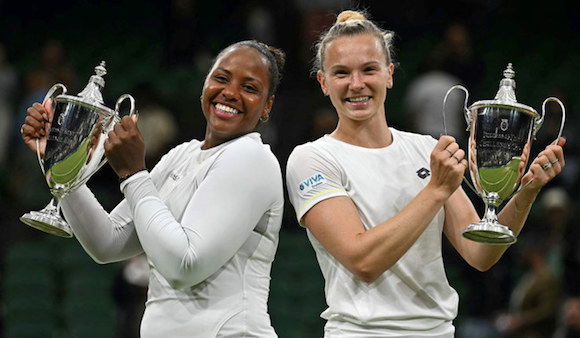
Wimbledon was the third event they’d played together, beginning with making the quarters of the Internazionali BNL d’Italia in May.
The pair then narrowly lost in the first round of the Bad Homburg Open, their grass court warm-up tournament.
At Wimbledon, they had several close matches on the way to the final, including in their semi against the winners of the Australian Open, Hseih Su-wei and Elise Mertens, who won two more total points but lost 6-3 4-6 4-6.
Their final against Erin Routliffe and Gaby Dabrowski was only two sets but each needed a tiebreak, Siniaková and Townsend winning, 7-6(5) 7-6(1).
While the victory provided Townsend’s first grand slam title, it became Siniaková’s ninth.
After the final, a delighted Siniaková told the world’s media, “I’m so proud of Barbora and I’m so happy that we could do it as well”.
Title photo of Wimbledon flowers by Simone Kemler