
At the age of 29, in her 46th grand slam appearance, Madison Keys won her first major at the Australian Open.
Only two players have taken longer to win their first slam. Marion Bartoli of France won Wimbledon in 2013 on her 47th attempt and Italian Flavia Pennetta won the 2015 US Open playing her 49th slam.
Keys was seeded 19 in Melbourne. Following her first two rounds, where she defeated unseeded opponents Ann Li and Elena-Gabriela Ruse, she had to get past seeds Danielle Collins (10), Elena Rybakina (6), Elina Svitolina (28), Iga Świątek (2) and Aryna Sabalenka (1) to get her hands on the trophy.
Not since 2005 when Serena Williams beat the top two seeds to become Australian champion has a player done it. The last time at any grand slam tournament was Svetlana Kuznetsova, who defeated Dinara Safina in the quarterfinals and Serena Williams in the final of Roland Garros in 2009.
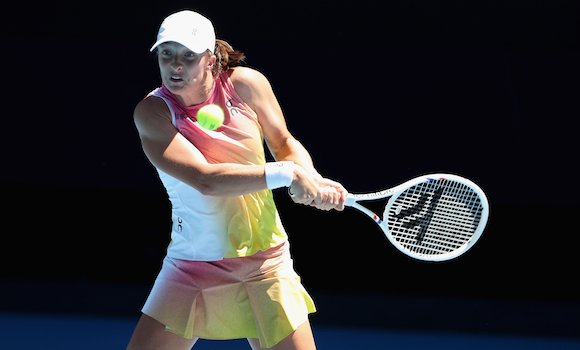
The Keys path to the Australian Open final included a red flag in the form of Iga Świątek. Keys had beaten Świątek in 2022 in Cincinnati but not before or since, including their two meetings last year.
Świątek had not dropped a set on the way to their semi and had lost only 14 games. She had not dropped serve in the previous four rounds. She had also spent nearly three hours less on court than her opponent.
Keys started the match by breaking Świątek, but it turned out that the first four games were breaks of serve. More tension and brilliance followed with Świątek managing a break for 7-5.
In the second set, Keys elevated her game further and raced away with only a hiccup near the end. A love game with three aces got her to 4-0. She broke Świątek again but was then broken for 5-1. The end of the set came as Świątek went down 0-40 on her serve. She managed to save two set points but couldn’t save the last.
Throughout the whole of the third set and subsequent match tiebreak, it was impossible to predict the winner. Both players had several break opportunities but were thwarted by the other’s brilliance. Close to the end, when it looked as if Świątek was about to take it, Keys somehow survived.
At 5-5, Keys was 0-40 and clawed back to 30-40. She drop shotted Świątek who reached the ball and from it conjured a winner down the line. Serving for the match, Świątek earned a match point at 40-30 but Keys defended it with a great return that her opponent couldn’t control. Another outstanding return earned her break back point, which Świątek gifted with a double fault.
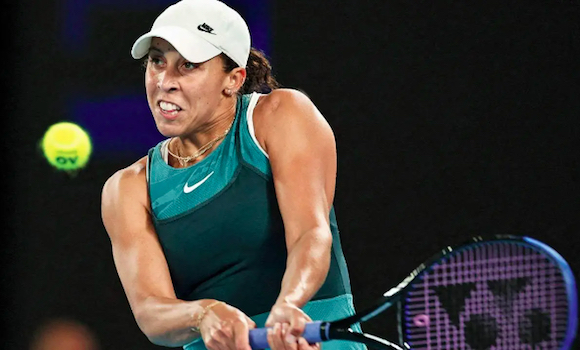
The match tie break was a fitting finale. Keys moved through five minibreaks against her, despite tiring as Świątek ran her all around the court. At 5-7 she won consecutive points as her winner was followed by Świątek hitting into the net and the score was level at 7-7.
In the next point, Keys managed to retrieve what should have been a winning volley only for Świątek to have guessed precisely the right place to wait at the net and reflex another volley into the open court. But an ace out wide drew Keys even again at 8-8. Suddenly, Świątek hit two shots long and it was all over at 8-10.
The 155 minutes of their semi provided one of the finest matches of the tournament.
Earlier that day, Sabalenka had defeated Paula Badosa in a more straightforward semi, 6-4 6-3 in 86 minutes. So Keys already knew that Sabalenka would be her rival for the trophy. After making the semis in Melbourne in 2015 and 2022, Keys finally had her opportunity.
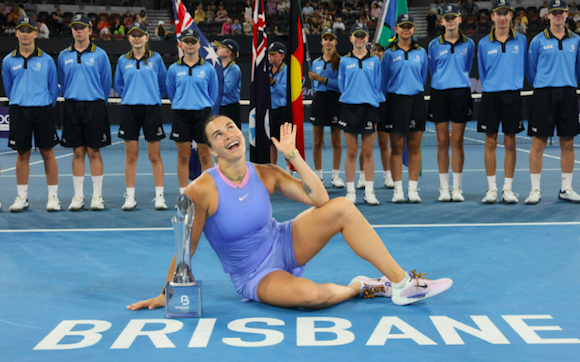
The finalists had arrived at Melbourne Park after winning their warm up events. Sabalenka won the Brisbane International over Polina Kudermetova, 4-6 6-3 6-2. At the Adelaide International, Keys beat compatriot Jessica Pegula for the title, 6-3 4-6 6-1.
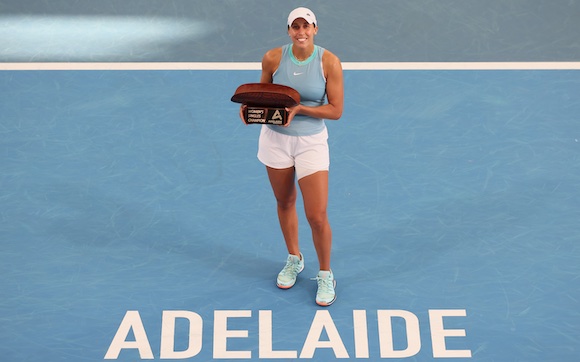
Putting her Adelaide win in perspective, Keys had said, “I think when I’m playing good tennis a lot of really good things can happen, and it’s just putting myself out there and continuing to give myself the opportunity to play good tennis, and a lot of times good things follow”.
Keys has added to her “opportunity to play good tennis” by continuing to fine-tune her game and equipment. With the support of her coach now husband, Bjorn Fratangelo, last year she changed her racquet from Wilson – which she had used since turning professional a few days after her 14th birthday – to Yonex. She also experimented with varieties of string, choosing all polyester over gut, and stringing patterns, moving from a 18 x 20 setup to 16 x 19. The changes gave her more control in her shot production.
Her serve was always one of the best in the game – free flowing with easy power and shape, accurately landing in all parts of the service box. During the off-season, she changed her service stance from platform to step up to be kinder to the troublesome shoulder that caused her to miss last year’s Australian Open.
Keys lost her only slam final, the 2017 US Open, as nerves affected her strokes and concentration, allowing Sloane Stephens to wallop her 6-3 6-0. Sabalenka had won in Melbourne the past two years.
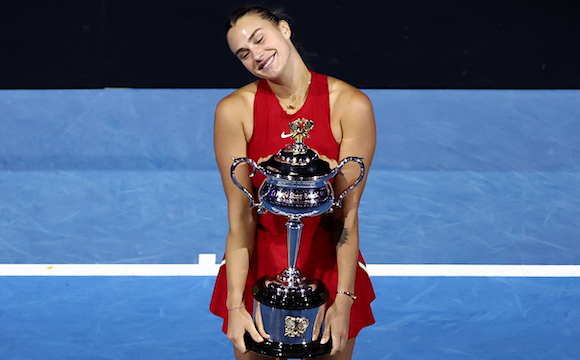
From the beginning of the 2025 final, Keys looked composed, while Sabalenka looked stressed, starting with a double fault and losing the first game.
Keys went for it and the score stretched to 5-1 in her favour. Sabalenka’s power hitting interrupted the flow and won her another two games. But her fourth double fault gave Keys a second set point, which she grabbed with a whipped backhand down the line for 6-3.
The American made 86% of first serves and played with great angles and depth.
Sabalenka went for a break and the question had to be asked, could Keys sustain the momentum?
The middle set started with three deuces on the Keys serve against a determined Sabalenka, but she held onto the game.
The reigning champion soon broke, then held, for 3-1. She had two break points for 4-1 and seized the break with a whipped forehand cross court past a lunging Keys. At 5-2, she converted her third set point. Throughout the set, Sabalenka had raised her level of play and reduced errors.
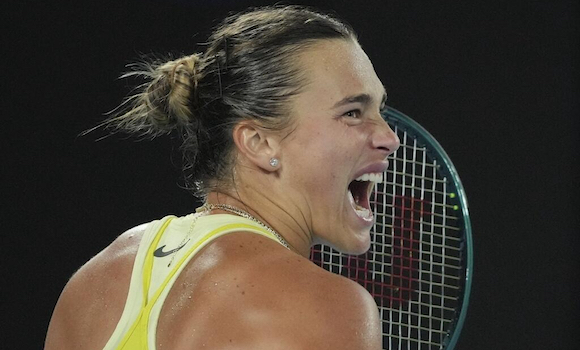
Unlike the previous two sets, the decider proceeded on serve to 6-5 for Keys. Even so, Sabalenka had a couple of holds to love, while Keys was twice down 0-30 but fought to hold.
Suddenly, Sabalenka was down 15-40 and offering up two championship points. On the first, Keys’s ball landed just out. But the next, she hit a great return followed by a wonderful off-forehand winner.
As she approached the net, Sabalenka berated her team though warmly congratulated Keys. Devastated at falling short of a three-peat of Australian Open titles, she promptly smashed a racquet then hid her head under a towel and wept, before leaving the court to recover herself.
After accepting the finalist’s trophy, she addressed her team, “I think we did our best, just Madison was playing incredible in this match”.
For Keys, with her team in tears and her voice trembling with emotion, she expressed relief and gratitude. “I have wanted this for so long and I have been in one grand slam final. It did not go my way and I didn’t know if I was ever able to get back to this position to try to win a trophy again and my team believed in me every step of the way. Thank you so much.”
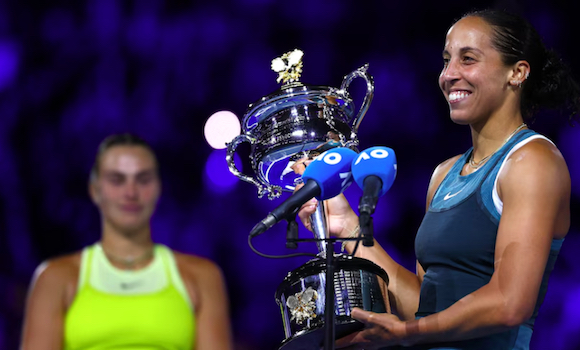
Later, an interviewer informed her that “No woman has lost more games than you and won the title”. She looked a little surprised at the inherent negativity of the comment, but accepted it as a positive.
It was just another illustration of her story in the tournament, which could be summed up by one word: resilience.
She won five three set matches and two tight straight-setters. And she had to play her best tennis twice in a row in the semi and final.
In the final, she overpowered Sabalenka – the player whose power can often crush opponents. Keys has plenty of her own, with a forehand speed faster than Sabalenka and many of the top men.
But the victory was not just about power versus power. A determined Keys knew that she must break the two-time defending champion – who would surely fight back, as happened in the second set – with precise returning.
She began with a strong game plan, and executed it as closely as possible. She made some errors, sometimes a few in a row, but kept working it out to get back on track.
For the new champion, her intelligence and nerves of steel surpassed even her power, in the 99th edition of the women’s championship at the Australian Open.




Title photo of Madison Keys winning the Australian Open by Jimmie48