Playing a final at The Championships is historic, whether it is the Gentlemen’s or Ladies’ singles event. It is made more meaningful by the fact the Gentlemen’s trophy chase began in 1877 and the Ladies’ in 1884.
Credited as the game’s oldest tournament, the annual gathering takes place in the rarefied atmosphere of the All England Lawn Tennis Club (AELTC). This year the tournament will run from June 30th to July 13th.
Winning guarantees a player’s reputation and bequeaths “Rolls Royce…” status. The resulting respect is career defining. Those who have achieved the distinction standalone…
To finally hold the Gentlemen’s Challenge Cup or the Ladies’ Venus Rosewater Dish, after having been a repeat finalist requires resilience and the confidence to overcome challenges. It is an adventure over time which, at last, results in success.
Counting the years between first reaching a final and winning is theme music worthy …and no tune is more fitting than The Kinks… “Tired of Waiting for You” … particularly since the lads who recorded the hit song – brothers David and Ray Davies, along with bandmates Mick Avory and Pete Quaife – came from Muswell Hill in North London, roughly sixteen miles from the AELTC.
Those who top the…
“So tired, tired of waiting
Tired of waiting for you…”
…charts include Jaroslav Drobný and Shirley Fry who appeared then achieved after five years. For Helen Jacobs the realization came about in seven years. Goran Ivanišević’s nine year delay was unmatched.
The lefthanded Drobný first played The Championships in 1938 and again in ’39 as a Czechoslovakian. During his career, he appeared at the AELTC 17 times. In 1949, he lost to Ted Schroeder of the US in the Gentlemen’s final, 3-6, 6-0, 6-3, 4-6, 6-4.
The Championships ended on July 2nd… 13 days later Drobný and teammate Vladimír Černík, who had led their country to the Davis Cup semifinals in 1947 and ’48, defected on July 15th while playing the Swiss Championships in Gstaad after receiving a “Do not play…” the tournament dictate from the Communist Party of Czechoslovakia, who staged a coup d’état in February 1948.
Drobný was a 4-6, 6-2, 6-3, 6-2 London finalist in 1952 to Frank Sedgman of Australia. In 1954, he defeated Ken Rosewall, also of Australia 13-11, 4-6, 6-2, 9-7, becoming the only Egyptian to win a Grand Slam title. In his final appearance at SW19 in 1960, he represented Great Britain having been naturalized in May of 1959.

Drobný’s story is unparalleled. He is the only individual to have played The Championships representing a travelogue of countries – initially, Czechoslovakia; then after the German invasion, the Protectorate of Bohemia and Moravia; following WWII, Czechoslovakia again; then Egypt, and finally, Great Britain.
An extraordinary two-sport star, Drobný was the center on the Czechoslovakian 1947 ice hockey World Championship gold medal winning team and played the same position on the 1948 Olympic team that earned a silver medal.
Ice hockey, though, did leave a mark. Thanks to an injury, he was forced to play tennis in tinted glasses and became the only glasses wearing male singles winner at The Championships…
In another “Only Drobný …” he was inducted into the International Tennis Hall of Fame in 1983 and in 1997 was honored by the International Ice Hockey Federation Hall of Fame.
“…But you, keeping me waiting, all of the time
What can I do…?

Shirley Fry was a Ladies’ contestant eight times, reaching the final in her fourth AELTC appearance… which was a disaster. In 1951, Doris Hart was invincible, dispatching her US countrywoman 6-1, 6-0. The 34-minute match is “the most one-sided” final in Ladies’ history at The Championships.
Fry and Hart were doubles partners and close friends. During their careers they shared fascinating, often amusing, tennis travel experiences. In 1951, they defeated four-time Ladies’ Doubles winners Louise Brough and Margaret duPont, 6-3, 13-11 in the final after losing to Brough and duPont, 6-4, 5-7, 6-1 in 1950.
The next year, Fry and Hart were 8-6, 6-3 better than Brough and Maureen Connolly. In 1953, their “Three Slam Year”, they embarrassed Connolly and Julie Sampson, 6-0, 6-0 in the Ladies’ Doubles final. Their dominance during the fortnight was “Total…” The champions won three matches without losing a game. Adding to the significance…Connolly and Sampson had won the Australian title, then they were Roland-Garros and US National finalists to the Ladies’ Doubles winners.
Sixty-four years later another “routing” took place…Russians Ekaterina Makarova and Elena Vesnina “Double Zeroed” Chan Hao-ching of Taiwan and Monica Niculescu of Romania in the 2017 Ladies’ Doubles final.
Moving to Fry’s Ladies’ Singles victory… In 1956, she overwhelmed Angela Buxton, 6-3, 6-1, the first British woman to reach the title round after WWII. Buxton gained historic recompense when she teamed with Althea Gibson. They became the first Jewish-Black Ladies’ Doubles champions, defeating Fay Muller and Daphne Sweeney of Great Britain, 6-1, 8-6 in the final.
“…But please don’t keep me waiting
Please don’t keep me waiting…”

Helen Jacobs of the US first appeared in the Ladies’ Singles final in 1929, losing to compatriot Helen Wills…three years later the result was the same, but the 1929 winner (now Wills Moody) lost one more game than in the first encounter.
Dorothy Round of Great Britain outlasted Jacobs, 6-2, 5-7, 6-3 in the 1934 title round. The following year, Wills Moody was better again…this time, 6-3, 3-6, 7-5.
Finally, in 1936 Jacobs claimed the Venus Rosewater Dish defeating Hilde Sperling, 6-2, 4-6, 7-5. The Ladies’ records identify Sperling as a competitor from Denmark. But Roland-Garros, where she was the women’s champion from 1935 to ’37, perhaps as a sign of the time, noted that she represented Germany in ’35 then Nazi Germany in ’36 and ’37. In addition, she was identified as Hilde Krahwinkel Sperling.
Like Wills Moody, Jacobs, who was born in Globe, Arizona, grew up in Berkeley, California. She developed her game at the famed Berkeley Tennis Club and attended the University of California-Berkeley. In Jacobs’ last Ladies’ final in 1938, Wills Moody scored a resounding 6-4, 6-0 victory.
Jacobs, a 12-time AELTC performer, was the first Ladies’ competitor to wear shorts rather than a skirt. During WWII, she was a Commander in Naval Intelligence, one of only five women to achieve the rank.
Eclectic in her approach to life, Jacobs wrote tennis instruction books and a library of novels… and designed tennis clothes and sportswear outfits.
Ivanišević is the last of the…
“…I’m so tired, tired of waiting
Tired of waiting for you, for you, for you…”
… to be considered.

Australian Bob Brett was a masterful coach who shared his expertise with the Canadian, Great Britain and Japanese tennis federations before opening an academy on the Italian Riveria in San Remo. Individually, he worked with an all-star cast of players. We became acquainted when he was guiding Boris Becker from November 1987 until February 1991 and visited regularly between 1991 and 1995 as he attempted to direct/restrain Ivanišević, the impulsive lefthander.
The Croatian played the mid-summer Los Angeles men’s ATP tournament several times. In 1995, he was the No. 1 seed at the Infiniti Open which took place at the Los Angeles Tennis Center on the campus of UCLA… and I had a chance to spend time during the week with Brett and watched him manage “Ivaniševićism…”
He did it by offering advice, with measured patience interspersed with lowkey humor… He used a glossary approach to deal with his zany, enigmatic, complex, entertaining charge…
Often unthrottled when expressing himself. He spoke “Goran…” which, from time to time, required clarity, having once, with a smile, admitted “…I just say things because I have nothing else to say…”
Brett was always looking to add to his encyclopedic coaching approach, so during the tournament, I was able to help him – thanks to the contact provided by Michael Sondheimer of UCLA Athletics – arrange a visit with John Wooden, the esteemed UCLA basketball coach known for his “Pyramid of Success” along with winning a record 10 NCAA Men’s Basketball Championships
In time, Brett thoughtfully emailed, “… I owe you one from your introduction to John Wooden in 1995. Just a few years ago but it seems just like yesterday. It was a wonderful experience…”
In 1995, Ivanišević was a 6-7, 6-4, 6-4 Infiniti Open Singles semifinalist to Thomas Enqvist of Sweden and with Scott Davis of the US was a 6-4, 7-6 doubles finalist to Brent Haygarth of South Africa and Kent Kinnear of the US.
Brett’s protégé once admitted, “My mind goes away. It goes to the beach…. I’ve told myself what I am doing is stupid. I play against five people every match – myself, my opponent, the umpire, the ballboys, everybody. Fighting with everybody… it is tough to win.”
Marat Safin of Russia was combustible …annually breaking racquets at a record setting crack. Ivanišević was a match. Individually, the unofficial career count on broken racquets was collectively 900+.
Adding to their similarities, they played with the iconic red Head Prestige Classic 600…Long and lanky at 6’4”, Ivanišević good-naturedly once said, “I was surprised at how easy I broke the racquet…There must be something wrong with the racquet, or I’m too strong.”
A performer who never looked like he was working to hit shots, Ivanišević played the game with a man-child impetuousness that appeared to be based on a weather forecaster’s ability for rarely knowing what was coming next.
Beginning in 1998, he played at the AELTC 15 times. His last appearance was in 2004 when he reached the third round.
In 1992, Ivanišević was a five-set finalist to Andre Agassi, when the American after losing three Grand Slam singles finals, won his first major. Pete Sampras was three-set efficient in the 1994 final.
After losing to Sampras 7-6, 4-6, 6-3, 4-6, 6-3 in The Championships 1995 semifinals, Ivanišević offered a free association masterpiece saying, “All match I was unlucky. Probably I was born unlucky. I don’t know why I can’t have luck one time in a big match, but I can’t. That’s it. I have to face it. Every time something is going to happen, some stupid call, or some guy is going to play good, or I am going to be unlucky.”
In 1998, the lefthander forced Sampras, the defending champion, to go the five-set distance in the title round.
In 2001, he borrowed from The Kinks lyrics…
“It’s your life and you can do what you want
Do what you like
But please don’t keep me waiting…”

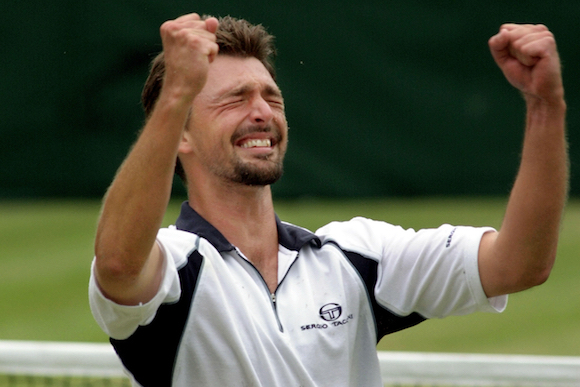
Ranked No. 125 prior to the tournament and with a dodgy left shoulder, Ivanišević needed a wild card to earn a place in the Gentlemen’s Singles…but in the final, he scored a dramatic 6-3, 3-6, 6-3, 2-6, 9-7 victory over Patrick Rafter of Australia. It was fitting, after failing to convert three championship points and beginning to unravel emotionally that he became the only Gentlemen’s wild card to win the Challenge Cup.
Serendipity would be an appropriate word to use to describe the unforgettable scenario. It took place on “People’s Monday” … brought about by rain delays during the fortnight… forcing the AELTC to issue tickets on a first come, first serve basis… resulting in a crowd whose boisterous enthusiasm was as captivating as the match…
Jaroslav Drobný, Shirley Fry, Helen Jacobs and Goran Ivanišević rephrasing The Kinks lyrics…
“Did what they liked…”
And finally…
“Were able to stop waiting…”