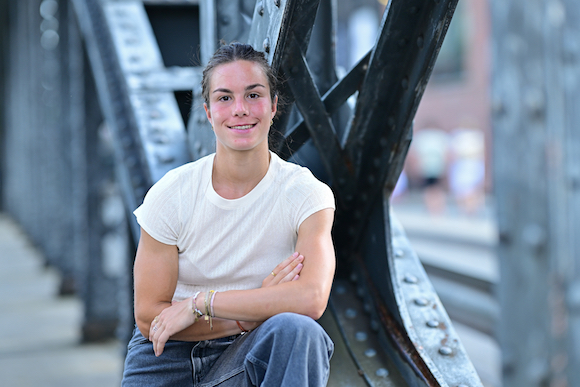
Lois Boisson was already the women’s tennis story of the year so far. But today the story’s grown as she won her first WTA main tour title in Hamburg.
At Roland Garros, ranked No. 361 in the world, Boisson made it all the way to the semifinals.
En route, she defeated 3rd seed Jessica Pegula, 3-6 6-4 6-4 and 6th seed Mirra Andreeva, 7-6(6) 6-3.
She ran out of steam in her semi, losing to eventual champion Coco Gauff, 1 & 2. Still, her remarkable run to the last four drove her ranking to its highest position, No. 63.
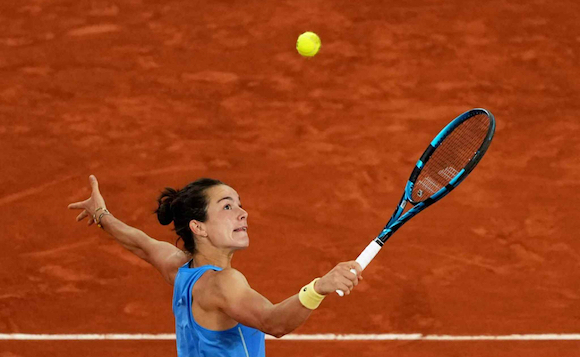
Prior to Roland Garros, Boisson was best known, at least to casual tennis fans, for a viral video when British player Harriet Dart requested of an umpire, “Can you tell her to wear deodorant? She smells really bad”. Boisson took the criticism in surprisingly good humour, posting a meme on Instagram of her holding a Dove deodorant with the tag “@dove apparently need a collab”.
The Frenchwoman’s tennis experience has consisted mainly of the lower tier ITF tour and W35-75 events, where her earnings per tournament were often in just hundreds of dollars.
She earned US$747,079 for her efforts at Roland Garros. Previously, her largest prize was US$13,040 for winning the WTA 125 in May, 2024.
Immediately before Roland Garros, she won a W75 and US$9142. The win assisted her to gain a wild card into the main draw in Paris. Three times before she had tried to get in the main draw of her home country slam. Once she lost in the second round of qualifying rather than the first round.
After Paris, she headed to Wimbledon without playing a grass warm-up event. She lost in the first round of qualifying, causing some to comment that her breakthrough in Paris was a fluke. Others thought that clay suits her game so much better than grass. The latter could be true.
The only other grass event she’d played was a stop on the ITF tour in 2019, when she was ranked 9999. Her opponents in the qualifying match and the first round both retired, sending her through to the second round, where she lost. So she had played three matches on grass without truly winning any of them. It must be added that she was only 16 at the time and the future could hold success on grass if she plays on it more often and learns to adapt.
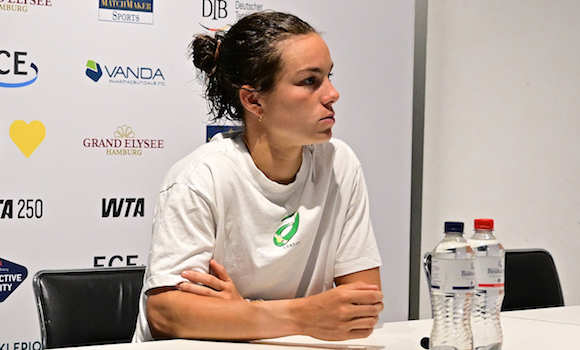
Boisson arrived at the MSC Hamburg Ladies Open, having played in the main draw of only one other WTA 250 tournament – Rouen 2025 – the scene of the deodorant controversy. There she had scored her first and only WTA main draw win, and for the loss of just three games.
Her toughest match on the way to the Hamburg final was in the second round, where she met Tamara Korpatsch of Germany. It was an intense and exhilarating battle of skills that towards the end, turned into a bizarre drama.
With Korpatsch leading 3-1 in the third set, she became stricken with cramps, mostly in her left calf. Soon she collapsed to the ground and couldn’t stand up for several minutes. After play resumed she limped around the court, determined not to retire.
As the crowd roared encouragement for the German, she resorted to hitting underarm serves and moonballs, and barely moved to the ball. Eventually, five minutes shy of three hours, she succumbed and went down 4-6 7-6 4-6.
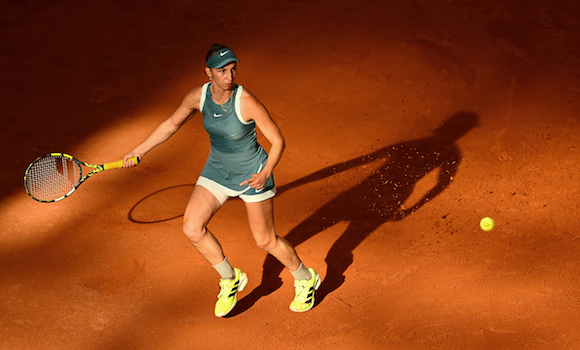
Boisson’s opponent in the final would be Hungarian Anna Bondár, the defending champion. But in 2024 the tournament was temporarily demoted to a WTA 125, due to the scheduling of the Summer Olympics. So, officially, Bondár was appearing in her first main tour final in the 2025 edition, as the main tour starts at the WTA 250 level.
She had three particularly difficult matches before the final. In the first round she played 2023 finalist Noma Noha Akugue, a homegrown Hamburg local, so obviously crowd favourite.
Despite the 175 ranking points difference between them, Noha Akugue threw everything she had at the three hour match.
Her powerful groundstrokes, inspired by her idol Naomi Osaka, created problems for Bondár.
But the German seemed to tire early in the third set and trailed 1-5. She determinedly saved three match points and forced the set to a tiebreak. Once there, she could only win three points, leaving a score of 4-6, 6-3, 6-7.(3).
The spectators gave her a rapturous send-off, acknowledging the talent and guts she’d shown. Despite losing the match, she had actually won a point more than the victor.
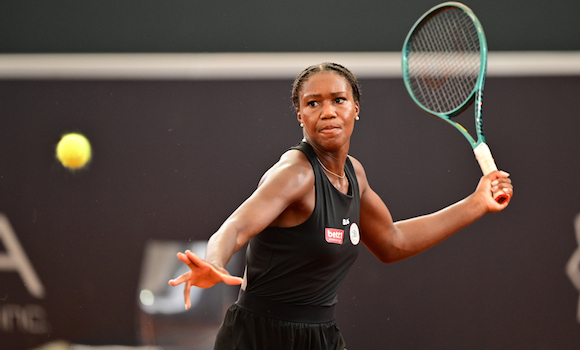
In the quarterfinals, 7th seed Bondár defeated top seed Ekaterina Alexandrova, 6-7 6-3 7-6(4), in just under three hours.
On the day, the difference between the players came down to Bondár’s 12 aces, with a single double fault, whereas Alexandrova served one ace which was more than cancelled out by her six double faults.
Bondár was also aided by some good luck at the right times. Her four match points began courtesy of a let cord for 6-2 in the deciding tiebreak, and then the net again helped her to win the last match point.
Next, Bondár and her unseeded Slovenian opponent Kaja Juvan played a semi displaying their touch and creativity with drop shots, angled volleys and lobs featuring prominently. Although Juvan lost 7-5 3-6 4-6, the match was so close that both players finished with 88 points won.
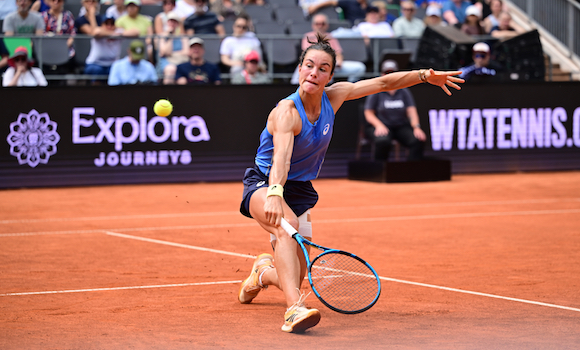
The final was an odd topsy-turvy match. As the first-time opportunity to capture a main tour trophy for both players, there were many nervous errors.
Bondár was by far the steadier player to begin with, breaking twice for 4-0, as some of Boisson’s serves seemed to land closer to the baseline than the service box, and the topspin forehand that her game is built around often failed to find the court.
Serving for the set at 5-2, Bondár was suddenly broken, as she watched a crushing forehand winner by Boisson, and then made a careless unforced error.
With her confidence lifting, Boisson held to love with a superb cross court drop shot that died when it touched the clay. In the following game, she broke again to draw level at 5-5. Although her serve problems returned, she saved each of Bondár’s three break-back points to take the lead for the first time.
Errors had infiltrated the Hungarian’s play and a wild volley saw her broken for the fourth time. Although Boisson was herself broken three times in the set, she had improved enough during its course to take it, 7-5.
In the second set, the players exchanged early breaks for 3-3. Then Boisson’s brilliant defensive skills came to the fore and she led 5-3. Serving for the championship, she saved a break point and on winning, let out her now traditional shriek of joy.
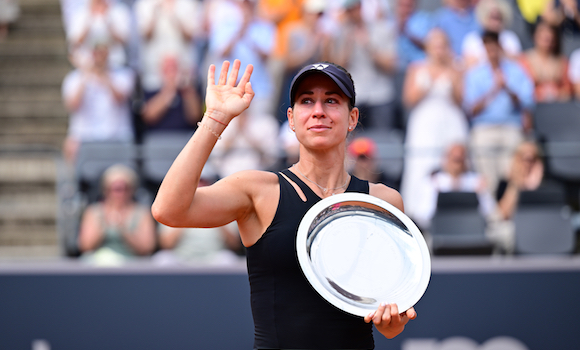
At the trophy presentation, an emotional Bondár was quick to acknowledge the winner.
“…You’ve shown you’re an amazing player, coming back from injury and playing like this in such a short time.”
From the semis on, Boisson played with heaving strapping on her left thigh. Nevertheless, after her semi when she was asked what she expected of the final, she had smiled and succinctly replied, “To win, for sure.”
After receiving the champion’s trophy, more an advertisement for the naming rights sponsor, Boisson began by saying, “It’s my first (winner’s) speech, so please be kind with me”.
She needn’t have worried. Her speech was fluent and concise, and included everything to be expected.
Turning her attention to tournament director Sandra Reichel, she said, “I would like to thank Sandra for the wild card because without (it), I was not supposed to play this tournament, I was not on the list.”
After congratulating Bondár, she added, “I hope that you will win the final in doubles this afternoon.”
Bondár was also a defending doubles champion. Unfortunately for her, there was no consolation in the doubles, as she and partner Arantxa Rus narrowly lost, 4-6 6-3 [9-11].
For Lois Boisson, the Hamburg chapter of her incredible story means a rise to No. 44 in the rankings – a move of 317 places in six weeks.
Title photo of Lois Boisson in Hamburg by MSC Hamburg Ladies Open / Valeria Witters
Update – 2026
Lois Boisson was unable to defend her title in Hamburg this year. She was forced to miss the tournament due to a knee injury.