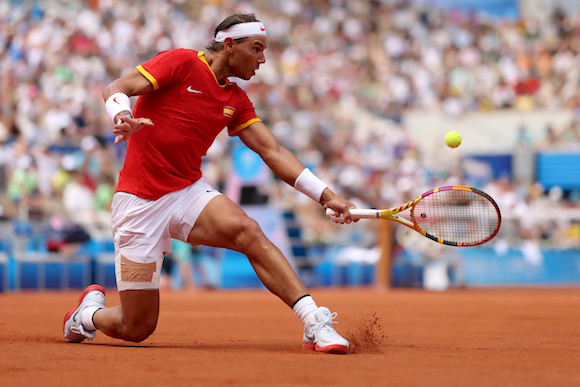
For Rafael Nadal, Paris 2024 began not with a tennis match but with the role of torchbearer. In a nice touch of symmetry, he collected the Olympic flame from soccer player Zinedine Zidane, who had presented Nadal with his first Musketeers’ cup at Roland Garros way back in 2005.
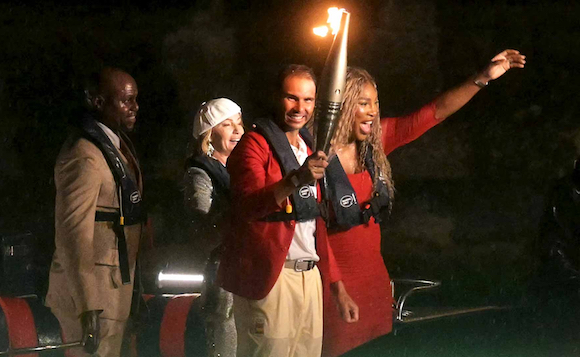
After walking the torch to the River Seine, he boarded a speed boat and found himself in good Olympian company. Former player Serena Williams shares the record of four Olympic gold medals in tennis with her sister Venus (who added a silver to her collection). S. Williams also has five Roland Garros titles; three singles, two women’s doubles.
The tennis players were joined on the boat by two other esteemed Olympians, five-time gold medallist in individual gymnastics Nadia Comăneci and sprinter/long-jumper Karl Lewis who owns nine gold medals plus a lonely silver.
The quartet was drenched with heavy rain as they sped down the river, trying to keep their balance as they stood to take turns holding the torch aloft. Williams especially struggled to find her “sea legs” in the gusting wind and Nadal gallantly escorted her back to her seat.
Eventually, the boat docked and was greeted by Amélie Mauresmo – silver medallist, two-time grand slam winner and now tournament director of Roland Garros. After Nadal lit her torch with his flame, Mauresmo continued on her way to the Louvre.
Nadal’s Olympic experience began 20 years ago in Athens. He played only men’s doubles and lost early with his partner, now coach, Carlos Moya.
Four years later in the humidity of Beijing, Nadal won his singles gold medal by defeating Chile’s Fernando González, 6-3 7-6(2) 6-3 (in the days where’s the men’s final was best-of-five sets).
In Rio 2016, Nadal was chosen as the flag bearer for the Spanish team. Although losing the singles bronze medal play-off to Japan’s Kei Nishikori, he paired with Marc Lopez to defeat Romanians Florin Mergea and Horia Tecau and take gold in the men’s doubles.
Having missed London 2012 and Tokyo 2020 due to injuries, this year in Paris became his fourth Olympics.
As an acknowledgement of his two Olympic gold medals and remarkable 14 championships at Roland Garros, it was fitting that Nadal appeared in the procession of torch bearers.
This year, he didn’t add any medals to his tally. But he played possibly for the last time at Roland Garros and gave tennis fans an opportunity to see him in action on the court where he won over half of his 22 grand slams.
In the opening round of the singles event, he got past Marton Fucsovics, 6-1 4-6 6-4. His second round match-up would still create great interest as a grand slam final despite the players’ recent injury battles: Novak Djokovic v Rafael Nadal.
It would be their 60th match.
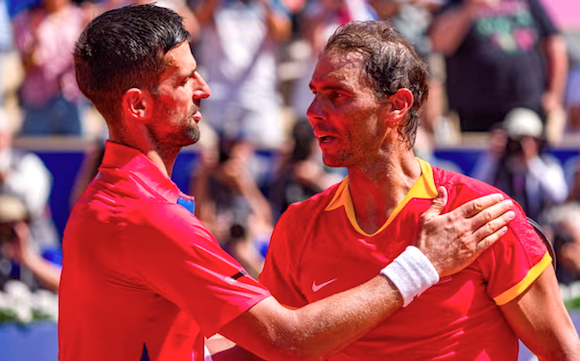
The first set was tough for Nadal. Djokovic was doing whatever he wanted all over the court. His returning was as good as it’s ever been and his backhand was the source of many winners. He went up 5-0 before Nadal managed a game, and took the set 6-1.
Late in the set, Djokovic had showed his class when Nadal’s ball looked like it was going long down the line, but landed right in the corner. It was called out but Djokovic just went over and wiped out the mark with his foot, conceding the point even though the score, on Nadal’s serve, would go back to deuce.
Djokovic began the second set by breaking for 1-0. The Serb stretched the lead out to 4-0 and it looked like Nadal had no answers. The crowd was mostly subdued as it was not the contest they had hoped for.
Still, Nadal applauded a couple of his opponent’s blinding winners.
Then something stirred in the Spaniard and he won a game, then a second when Djokovic double faulted, then another with steady serving; and to draw level at 4-4 he seized a second break point opportunity by whipping a forehand past Djokovic at the net.
But despite the urging of the crowd, that’s where the revival stopped. In the tussle that was the next game, Nadal saved three break points but still Djokovic claimed it. He then served out the match with an ace.
After the 6-1 6-4 win, Djokovic continued on to the final and his first Olympic gold medal.
Nadal lasted longer in the doubles, where his partnership with Carlos Alcaraz coined a new portmanteau name: Nadalcaraz.
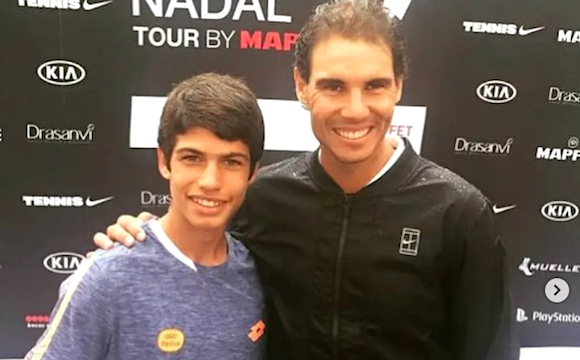
The first round was also their first doubles match together. It was obvious that the pair had not yet worked out the best way of combining, but still they came away with a win over Argentina’s Maximo Gonzalez and Andres Molteni. After a close first set, which Nadal’s doubles experience won for Spain, Argentina went up 3-0 in the second. Alcaraz lifted to get his team back to 3-3.
His sizzling return cross court to the corner broke Molteni’s serve for 5-3, leaving Nadal to serve it out as the Nadalcaraz smashes and volleys became weapons. The 7-6(4) 6-4 result took them to a second round against the Netherlands.
Represented by Tallon Griekspoor and Wesley Koolhof, the Netherlands forced a match tie break to decide the 142 minute match.
Sometimes it seemed to be the power of Spain versus the variety of the Netherlands. Both Nadal and Alcaraz belted their forehands, smashes and returns for all they were worth, while the Netherlands crossed often, angled volleys and landed precise lobs.
At 3-3 in the first set, Alcaraz broke and that was enough to carry Spain through the set to 6-4.
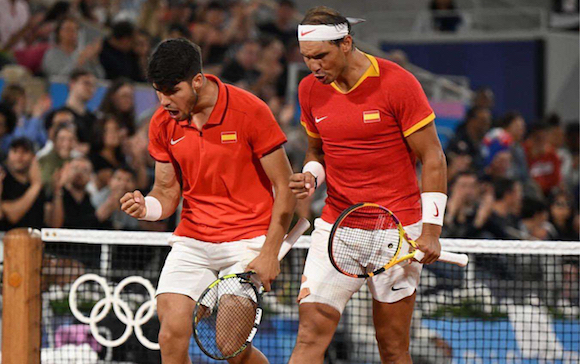
In the second set, Koolhof decided to play a couple of killer smashes of his own at crucial times. At 5-5 he saved a break point and at 6-2 in the eventual tiebreak he won the next point and set for the Netherlands.
Griekspoor and Koolhof played some exceptional tennis during the match but the Spanish ran away with the match tiebreak 10-2.
So, Spain made it to the quarter finals to play doubles specialists and 4th seeds Austin Krajicek and Rajeev Ram of the USA. From the beginning of the match, USA controlled the net with aggression and precision.
The Americans broke Nadal immediately and were gifted a second break to go 5-2 through the consecutive double faults of Alcaraz. Ram then served it out.
With the score on serve at 3-3 in the second, Alcaraz went down 0-40, giving the USA three break points. Ram’s emphatic return won the first of them.
As USA served for the match at 5-4, Spain got three break points but couldn’t convert any. The game swung the other way and now Nadal and Alcaraz needed to save the match points against them. They saved the first, but Krajicek took the second with an ace out wide. The umpire checked the mark and confirmed the ball had touched the line. The Spanish players accepted her decision, embraced, and then walked to the net to congratulate the winners.
Krajicek and Ram went on to win silver for the USA.
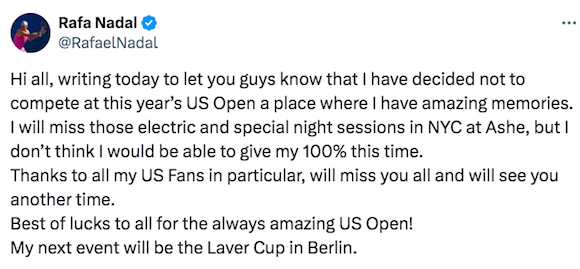
Nadal has announced that he will skip this year’s US Open but in September will play the Laver Cup in Berlin.
Any other playing plans he may have or be considering – or any retirement plans – he is keeping to himself.
Title photo of Rafael Nadal playing at the Paris Olympics by Getty Images
Update
On Friday 13 September, Rafael Nadal announced he was withdrawing from the Laver Cup, a week before its start.
Nadal did not refer to any injury but said, “This is a team competition and to really support Team Europe, I need to do what’s best for them and at this moment there are other players who can help the team deliver the win.”
Update
Ten days later on 23 September, Nadal was named as part of the Spanish Davis Cup team to play in November. Under captain David Ferrer, Nadal will join Carlos Alcaraz, Pablo Carreno Busta, Roberto Bautista Agut and Marcel Granollers in the team.
Update
On the 10 October, Nadal announced that he will retire immediately after the Davis Cup final.
“I am very excited that my last tournament will be the Davis Cup representing my country. It’s closing the circle because one of my first joys was the final in Sevilla in 2004.”